Wholesale ecommerce for a DTC brand: the volume is real, the customers aren't yours
Selling your products in bulk to shops that sell them on, more often now through trade orders online. It brings volume and reach, and hands the end customer to somebody else.
- 152Wholesale
- The sale of goods in large quantities, typically to be retailed by others. In ecommerce, it involves selling products to other businesses rather than directly to consumers.
- Also called
- Trade, B2B, or selling through stockists and retailers
- Priced at
- A trade price, below what the shop charges the public
- You don't get
- The end customer's name, email address or order history
- Clashes with
- Your own sales, whenever your emails undercut the shop
Wholesale commerce used to mean a sales rep, a trade fair and an order form. Most of it now happens online, through a trade login, a wholesale marketplace or a reorder email, and that changes what your website and your emails have to do.
What wholesale ecommerce means
Wholesale is selling your products in bulk, at a trade price, to businesses that sell them on to the public. Wholesale ecommerce is doing that online, and you'll also see it written as wholesale e-commerce. A stockist logs in to a trade area on your website, or orders through a wholesale marketplace, sees trade prices and places an order by the case without a phone call or an emailed spreadsheet.
Ecommerce wholesale gets talked about two ways. For a brand, it means adding a trade channel next to the shop it already runs for consumers. For ecommerce wholesalers and distributors who only sell to the trade, ecommerce for wholesalers means moving a catalogue of bulk consumer goods onto a site that trade buyers can order from at any hour. This page is written for the first group, the brands, though most of the website advice applies to both.
| A consumer order | A wholesale order | |
|---|---|---|
| Who buys | The person who'll use it | A shop, a salon, a café or a distributor |
| Price | Your public price | A trade price, with room for the stockist's margin |
| Size | One or two items | By the case, often with a minimum order |
| Payment | At the checkout | Often on terms, against an invoice |
| The end customer | Yours, with their email and history | The stockist's |
| What email does | Welcome, abandoned cart, post purchase, winback | New lines, reorder reminders, trade news |
What wholesale changes in a DTC brand's numbers
Wholesale is a trade plenty of growing brands make. A stockist orders by the case, pays on terms and puts you in front of people who'd never have found your website. In return you sell at a trade price, so the shop can add its own margin and still charge the public what you charge.
So the orders get bigger and the margin per unit gets thinner. That's a fair swap when the stockist reaches customers you couldn't. It's a bad one when it's your own customers buying the same thing somewhere you can't see them. Your gross profit margin on a trade order is the number to work out before you agree a trade price.
What a wholesale ecommerce website needs
A trade buyer wants to log in, see their prices, order quickly and get an invoice. A consumer shop with a discount code bolted on doesn't do that well, so most brands that sell wholesale online end up with these pieces.
- A trade account sign-up that you approve by hand, with the business name and VAT number captured.
- Price lists, so each account sees its own trade prices and the public never does.
- Minimum order quantities and case packs, so nobody orders a single jar at trade price.
- Payment terms and invoices for accounts you trust, and card payment for new ones.
- A quick order form and one-click reorder, because trade buyers order the same lines again and again.
- Stock shown honestly, so a shop doesn't promise its customers something you can't send.
- Separate shipping rules for pallets and cases.
On Shopify, the built-in B2B tools handle company accounts, price lists and payment terms. Check which plan you need for them, because wholesale apps cover similar ground on the others. BigCommerce sells a B2B edition of its own. If you're choosing between them, the ecommerce platform page sets out what to compare.
Plenty of independent shops also order through wholesale marketplaces such as Faire and Ankorstore, which find stockists for you and handle the payment. They work like any other marketplace: easy reach, and the marketplace sits between you and the buyer.
The stockist's customer never reaches your list
The awkward part for retention is simple. When somebody buys your product in a shop, the shop gets the sale and the relationship. You get no name, no email and no say in whether they come back. If they love it, they'll probably go back to the shop.
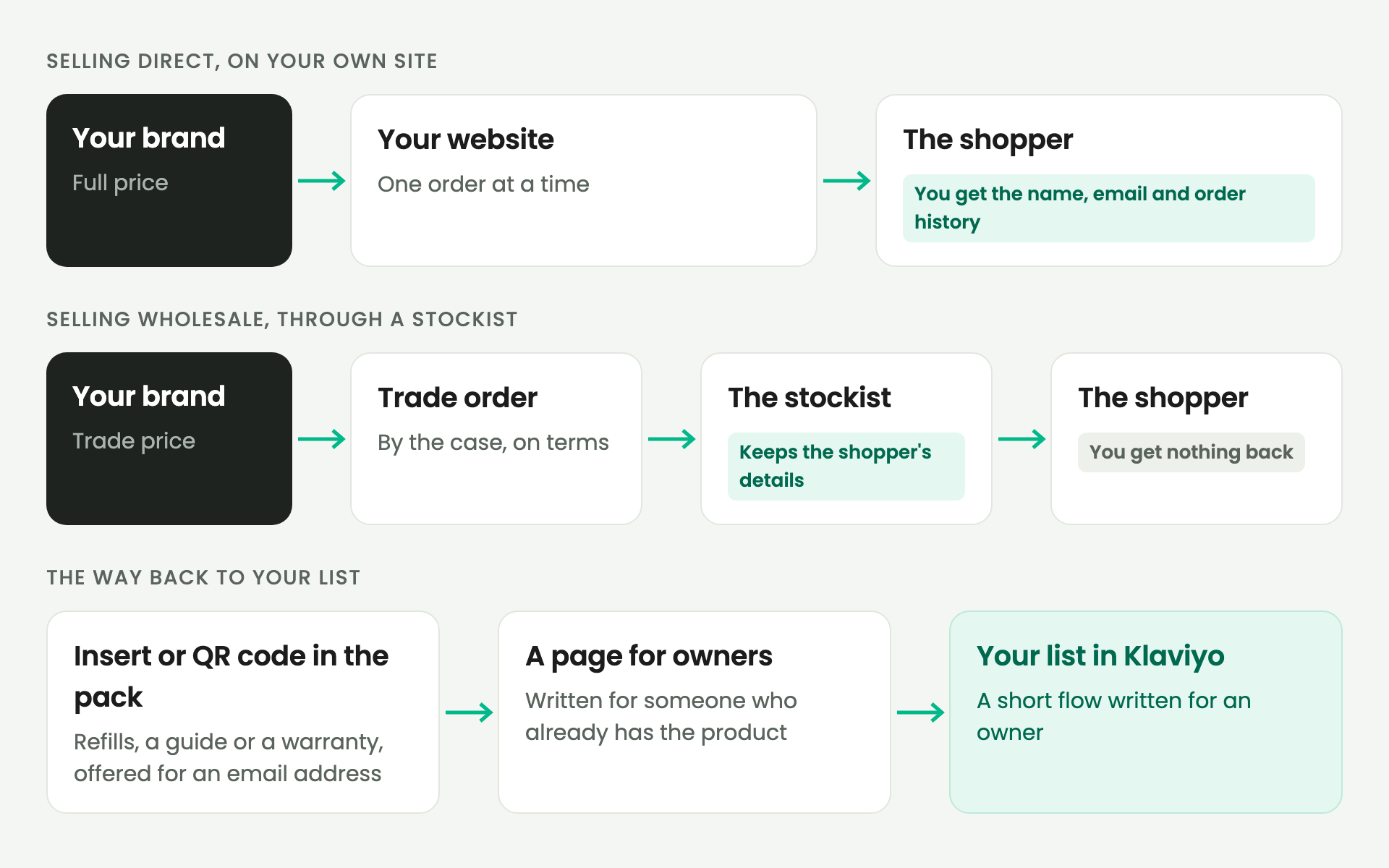
The way across is the product itself. Packaging, an insert or a QR code that offers something worth an email address: a refill, a recipe guide, a warranty registration, first look at new flavours. Point it at a page built for people who already own the thing, then send a short flow written for an owner, the same route the marketplace page lays out.
Agree it with your bigger stockists first. Some won't love a card in the box that sends their customer to you, and that's a conversation better had before the print run.
Keeping your own emails from undercutting stockists
This is where wholesale and email bump into each other. A sitewide sale, a generous welcome code or a flash sale to your list all sell the product below the price your stockists charge. They notice, and it comes up at the next reorder.
- Keep a public price you'll defend, and let your own site win on range, bundles and early access
- Tell stockists about a sale before their customers do
- Tag trade accounts in Klaviyo, so consumer campaigns can exclude them
- Give stockists their own emails: new lines, reorder reminders, point of sale material
Email and online marketing for your wholesale accounts
Most wholesale digital marketing is plain customer communication with the shops that already stock you. Keep it in the same Klaviyo account as your consumer email, in its own segment, so you can see both and never send one the other's offer.
- A reorder reminder timed from each account's last order, built the same way as a consumer replenishment flow.
- New lines and seasonal ranges, sent early enough for a shop to order ahead of the selling season.
- Point of sale material, product photography and copy a stockist can use on their own website and social pages.
- A short welcome for every new trade account, covering how to order, the minimums, the terms and who to call.
Wholesale partners are businesses, so the consent rules differ from your consumer list. The second question below covers the UK position.
Related terms
FAQs
Should a DTC brand sell wholesale?
If the stockist reaches customers you couldn't reach yourself, usually yes. It's reach and steady volume without buying every visit. If it mostly sells to people who'd have bought from your website anyway, it's thinner margin on the same customers. Look at who shops with a stockist before you sign.
Can I add my stockists to my marketing email list?
You can email them, but keep them off your consumer list. In the UK a company address sits outside the consent rule for marketing email, a sole trader's doesn't, and both need a way to opt out. Most stockists want trade news, not consumer offers, so give them their own segment. This isn't legal advice.
How do I stop my promotions upsetting stockists?
Decide your public price and protect it. Win on your own website with range, bundles, subscriptions and early access, not deeper discounts. When you do run a sale, warn your stockists first, and keep trade customers out of the consumer send so they don't read about it in their own inbox.
What is a wholesale account?
It's a trade customer's account with you. Once you've approved them, it lets a shop or salon see trade prices, order in case quantities and, if you offer it, pay on terms against an invoice. On a wholesale ecommerce website it's the login that separates trade buyers from the public.
Do I need a separate website for wholesale?
Usually not. Most platforms can run a trade area inside your main shop, with trade prices shown only to approved accounts. A separate site makes sense when the trade catalogue, the pricing or the people running it are very different from your consumer shop. One site keeps the stock and the product data in one place.
Rather we explained it on your own account?
Bring your Klaviyo account to a growth consultation. We'll walk through what this means for your numbers, in plain English, and what we'd fix first.


Half an hour with Theo, our founder.
We're all about relationships built on trust, mutual respect and a shared vision for success. If that sounds like your vibe, let's make some waves together 🌊