Most stores never capture emails from guest checkout, and they already paid for those clicks
Shopify collects an address on every guest order. What it never collects is permission, and the checkbox under the payment fields never gets it.


A customer clicks the ad, checks out as a guest and pays, and you're never allowed to email them again. The address is already sitting in your order data. What's missing is consent, and where you ask for it decides whether you ever get it.

The click is paid for and the address never arrives
Guest checkout is the right call. It's also where the list quietly stops growing. A customer clicks your ad, adds to cart, checks out as a guest and pays: clean transaction, happy customer, and acquisition spend burned on somebody you can never email again. You paid for the click and the conversion, and never got the one asset that turns a single sale into a relationship.
It shows up as a thin Klaviyo list, so it gets filed as an email problem. It isn't one. It's a CRO problem, and it lives in one specific window of the checkout flow that most stores get wrong in exactly the same way.
Shopify already has the address, it just can't use it
Guest checkout exists because forcing account creation kills sales. Every extra field between deciding to buy and actually paying costs you orders, so stores rightly let people buy without a password. The mistake is reading guest as no data, when the only thing that has to stay optional is the account.
Shopify collects an email on every order, guest or not, because the receipt has to go somewhere. What it doesn't collect is marketing consent for that address. So legally and practically, it can't join your campaign sends. The address sits in order data, unusable, while the ad account keeps charging you for the next cold click.
Multiply that across every guest order and your list is smaller than the traffic ever justified. Fixing it needs no new spend. It needs a different decision about where in the flow you ask.
The checkbox under the payment fields is read by nobody
There are two lazy fixes and they fail in different ways. Forcing an account gets you the address every time, and an abandoned checkout every time somebody refuses to set a password to buy a t-shirt. That trades a marketing problem for a revenue problem, and only one of those is fixable later.
The second is the consent checkbox parked under the payment fields, in small grey text, unticked. Most stores end up here once account creation is off the table, and it barely moves anything. The fault isn't the wording. It's the position.
By the payment step a buyer is in finish-the-task mode. Card number, expiry, billing address, place order. Attention has narrowed to the required fields, and anything optional gets skipped on principle. A checkbox sitting there goes unread, however carefully it's phrased.
The cart and the shipping step are yours, payment isn't
The cart, drawer or full page, is your own storefront code. You control every pixel of it, so a clearly worded opt-in line can sit there with no platform restriction and no bolted-on look. The shipping step is more constrained, but reachable through checkout extensibility on newer Shopify setups.
Shipping is also a page where people are still deciding things, weighing delivery speed against cost. Attention is active there in a way it stops being once card fields are on screen. Payment is the one step to leave completely alone: anything you add there competes with card details and loses.
So the rule on any Shopify build we do is short. The opt-in lives in the cart or on the shipping step, never on payment. That's the only part of the flow where there's still attention to spend on something optional.
We placed the same line three times before it worked
We've built this into three separate stores, and the honest version is that we got the placement wrong twice before we got it right. The copy barely changed across the three attempts. The position did all the work.
First build, the opt-in sat at the bottom of the cart drawer, under the checkout button. Nobody scrolls past the button, because the button is the whole point of opening the drawer. It converted close to nothing.
Second build moved it to the cart page, above the subtotal, where it fought the shipping estimate, the trust badges and a cross-sell block, and read as one more line item. Third build put it on the shipping step, directly under the delivery method choice, as one plain sentence. That's the version that pulls its weight.
The lesson isn't put it on the shipping step. It's that position beats copy whenever you're fighting for attention that's already been spent elsewhere on the page. Test the line where people are still deciding, not where they're executing.
Walk your own checkout as a guest before touching code
- A marketing opt-in exists in the cart or on the shipping step, because guests never reach account creation
- It's unticked by default, because that's what several markets require
- It sits away from the payment fields, somewhere you'd honestly notice it mid-checkout
- It reads as one plain sentence, not a legal-style label nobody parses in two seconds
- A successful opt-in really syncs to your email platform, instead of sitting in Shopify customer data doing nothing
Most stores fail on the first point or the last. Either there's no opt-in where the attention is, or there's one and it's quietly wired to nothing. The second failure is worse, because it looks like the job's done.
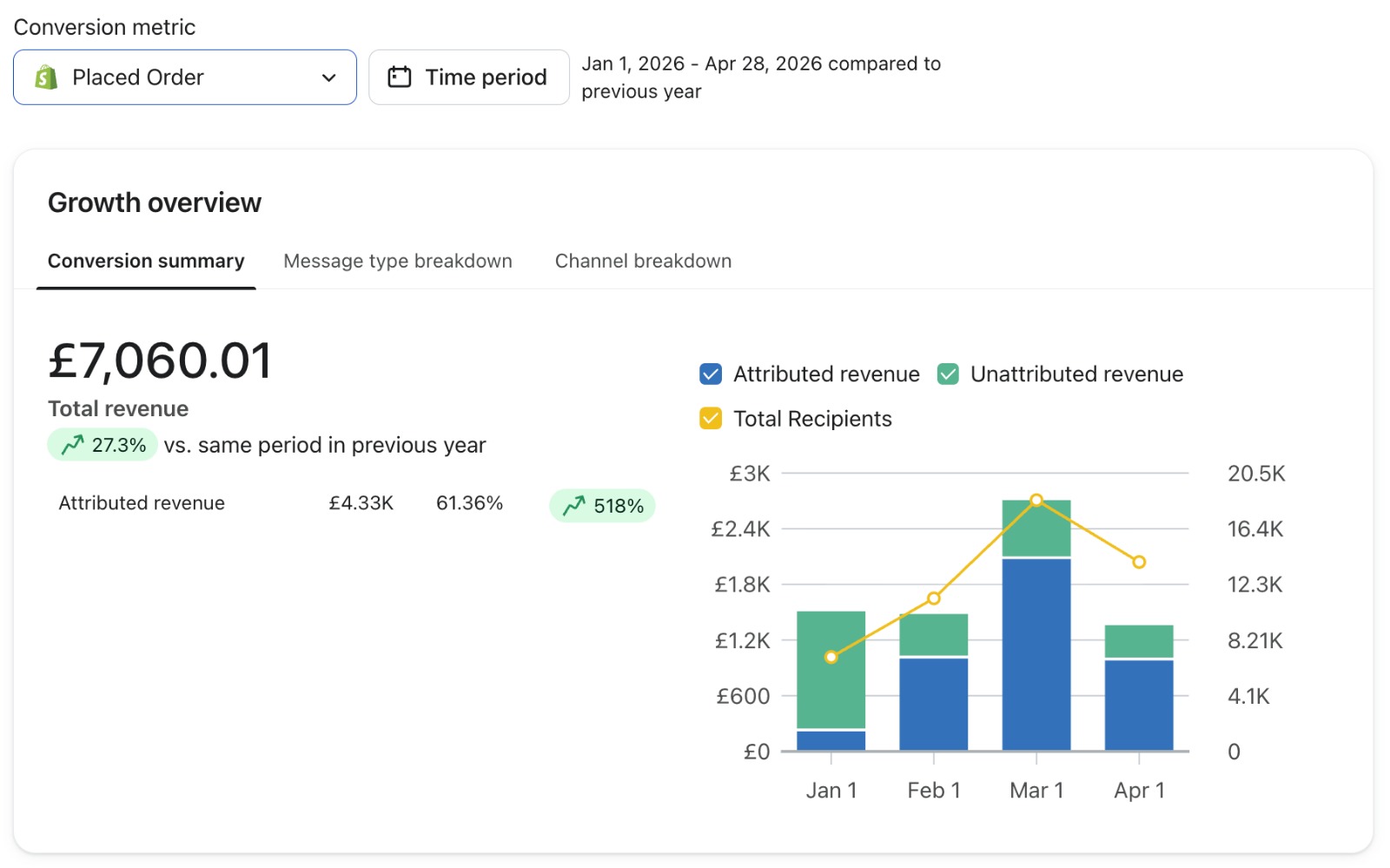
Wire the sync properly and the proof turns up in attribution within weeks, because recipients climb and attributed revenue climbs with them. That view is what a checkout feeding the list looks like. If yours stays flat while guest orders pour through, the second half of the job never happened, and the accounts behind our case studies all had this checked before a single campaign went out.
Theo Tziapouras
Founder and strategy at Engage Commerce, the ecommerce agency for 7 and 8 figure DTC brands.
FAQs
Does Shopify collect email addresses from guest checkout?
Yes. Every order needs an address for the receipt, so the email is captured whether or not an account gets created. What Shopify doesn't capture by default is marketing consent for that address, and without consent it can't go into campaign sends. The data exists. The permission doesn't.
Can I email guest checkout customers without a marketing opt-in?
Not for campaigns. UK rules allow a narrow soft opt-in for similar products where the customer had a clear chance to refuse at the point of sale, but leaning on it without that refusal mechanism invites complaints. A clear opt-in in the cart or on the shipping step is simpler and safer.
Should the marketing checkbox be ticked by default?
No. Several markets require it unticked, and a pre-ticked box collects addresses from people who never chose to hear from you. Those addresses open nothing, drag engagement down and teach mailbox providers to doubt you. A smaller list of people who actually ticked the box beats a padded one.
How do I get checkout opt-ins into Klaviyo?
Shopify's native Klaviyo integration syncs the consent status collected at checkout, so a properly captured opt-in lands as a subscriber with consent attached. The usual failure is a custom checkbox writing to a metafield or order note nothing reads. Place a real guest order and follow the address end to end before you trust it.
The list you already paid for
Every guest checkout without an opt-in is a customer you own and can't reach, and no amount of clever campaign copy fixes a list that was never built. The addresses are flowing through your checkout today. The only question is whether you're asking permission somewhere a buyer is still capable of saying yes.
Programme and calendar
How often to send, what to send when, and what retention costs to run.
TikTok Shop customer emails are the cheapest ones you'll ever nearly lose
The order arrives as a name, an address and a SKU, with no way to speak to the buyer again. Fix that on purpose.
Read it
Shopify email capture is what turns a website into a list machine
The site takes the first order. The list pays for every order after it, so each template has to earn its place with an ask.
Read it
Should you email your entire list? Half my job is saying not today
A full list blast spends your best customers' attention on people who stopped reading months ago, and the bill arrives weeks later.
Read itWould you rather this was just handled?
Bring your Klaviyo account and the thing annoying you most. We will tell you what we would fix first, before you spend anything.

Half an hour with Theo, our founder.
We're all about relationships built on trust, mutual respect and a shared vision for success. If that sounds like your vibe, let's make some waves together 🌊