A press mention isn't a sale, but email can turn press coverage into sales
Borrowed trust from a journalist expires in days. A capture flow built before the piece runs is how you keep it.
The morning after a national feature, the group chat is glowing. Days later revenue has barely moved and somebody asks whether the PR was worth it. It was. The fault sits in the handoff, in what greeted the reader after the click.
The press did its job, then the homepage threw it away
Coverage feels like the finish line. It isn't. A client rang the morning after a national feature telling us to look at the group chat, then rang again four days later in a very different tone: traffic back to normal, revenue barely moved, and had the PR been worth it at all.
It had. A journalist at a title his customers trust made the case for the brand, and readers clicked through mid-article already half convinced. What they landed on was the homepage. Same hero banner, same shop now button, same copy written for a stranger.
Nothing on that page said why the visitor was there. So the writer who vouched for the brand got no credit and the moment evaporated. That's not a traffic problem, it's a handoff problem. It's the difference between coverage you screenshot and coverage that sells.
A press-referred visitor arrives with the trust already built
Treat every visitor the same and you under-convert your best traffic while over-serving your worst. Somebody clicking a Meta ad is cold, mid-scroll, needing convincing from zero. Somebody clicking through from a feature in a title they already read has had the credibility argument made for them.
That borrowed trust is the real value of coverage earned through digital PR, and it's the part most brands throw away. This visitor isn't asking whether to trust you. They're asking what to do next. Much shorter question.
If your paid funnel is built to persuade, your press funnel should be built to confirm. Confirmation is quick, specific and cheap to build. It just has to exist before the click happens.
| Cold ad click | Press referral | |
|---|---|---|
| What they know | Nothing beyond the ad they scrolled past | A trusted title's case for you, already made |
| The question in their head | Should I trust this brand at all | I trust the write-up, so what now |
| What the page has to do | Persuade from zero | Confirm, then point at one next step |
| The popup that fits | A broad welcome offer | The publication's name and a reason to stay in touch |
| The first email | The founder story and a nudge | A link back to the piece and a guided first step |
Build the capture before the piece runs, as you would for a launch
None of this needs a new website. It needs a capture moment built for one window: a popup or a banner on the page the article links to, saying plainly that yes, this is us, here's the piece, here's the next step. For most Shopify brands that next step is joining the list, not buying on the spot.
The usual sequence runs backwards. The piece goes live, traffic spikes, somebody asks whether we should do something with it, and by the time anything's built the spike is three days gone. Time the flow to the PR calendar, not to the panic afterwards.
So treat a confirmed press date the way you'd treat a launch date. Feature lands on Thursday? The capture flow is live and tested on Wednesday, on the actual page the traffic will hit. And if the piece is about your bestselling candle, send readers to the candle, not to the full catalogue.
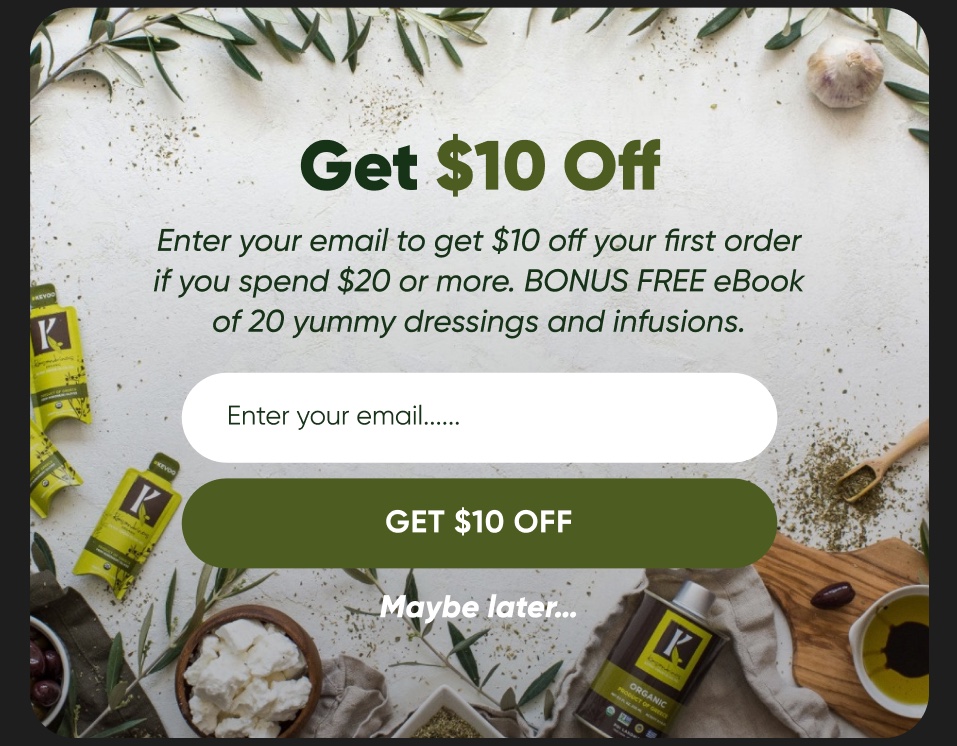
The build itself is a template job, not a project. A triggered popup, the title's name, one line of context and an email field. A standard welcome popup like the one above earns its keep on cold traffic; the press variant swaps the discount headline for the publication's name and fires only for referred visitors.
Write the popup and the first email to confirm, not to sell
Most popups sell. This one should confirm. A box saying sign up and save on your first order hands a vouched-for reader the same pitch you'd give a stranger off a cold ad, ignoring everything they just read.
Open by naming the thing that got them here: you spotted us in the publication, here's what to know. That one line does more conversion work than any offer, because it tells the reader you know exactly why they clicked.

The first email after signup needs the same discipline. Acknowledge the article, link back to it, then bridge from a journalist rated us to here's where we'd point you first. Save the founder story for later. Unless the piece was about the founder, in which case lean in harder.
PR gets the door open, and the email programme is what walks somebody through it. The two have to work as one mechanism, not two budget lines. Most brands underperform their coverage because they buy the placement and stop.
Tag the source, because this cohort behaves differently for months
People who sign up because of a press mention aren't the same as people who caught a discount popup on a normal Tuesday. Drop both into one generic welcome flow and you lose the advantage a second time, quietly, later. The tag costs nothing at capture and can't be added afterwards.
Months on, that segment is still the cohort a publication vouched for, and you can say so: since you found us through the title, you should hear this first. That's the difference between a list and a list where you know why every name is on it.
Timing slips unless it's a fixed sequence. So run this before any confirmed placement goes live.
- Confirm the exact page the article will link to, and build a matching landing moment if that page is generic
- Set the popup to fire on referral traffic from that title, not on every visitor
- Write popup copy that names the publication, instead of saying as seen in the press
- Draft and load the first email before the piece runs, referencing the actual coverage
- Tag every signup from the flow with its source, so it survives as a segment
- Have it all live and tested the day before the confirmed publish date
Skip one step and you're back to screenshotting the group chat while the spike dies on a homepage that never said why anybody came. The brands getting the most out of coverage in our client work had this flow built before the first placement ran.
Theo Tziapouras
Founder and strategy at Engage Commerce, the ecommerce agency for 7 and 8 figure DTC brands.
FAQs
Do I need a separate landing page for every press mention?
No. If the article links to a specific product or collection, a source-triggered popup on that page usually does the job. Build a dedicated landing page only when the linked page is generic, like the homepage, or when the piece makes a claim the page doesn't repeat anywhere.
What if I don't know when the piece will publish?
Build it anyway and leave it dormant. Most placements come with at least a rough window, so ask the journalist or the agency for the expected date. Set the popup to fire on referral traffic from that domain, and switch it on the moment the link goes live.
Should press-referred visitors get a discount?
They can, but frame it as a thank-you tied to the publication rather and not a blanket code. A vouched-for reader isn't price-shopping, they're checking you out. A generic code teaches them that you discount for everybody, which spends the trust instead of banking it.
A press mention is a reason to email somebody
Go and look at the coverage your brand earned in the last twelve months, small trade write-ups included. Two questions. Was anything built for that traffic, and is there a tagged segment in Klaviyo for the people it brought in? If both answers are no, the gap is an unbuilt email flow, and that's a far cheaper fix than another placement.
Programme and calendar
How often to send, what to send when, and what retention costs to run.
Exit intent popups are annoying because they fire on the wrong page
One trigger, five different moments. The page decides what a popup should say, and a site-wide discount teaches repeat visitors to close it on reflex.
Read it
Your subscription cancel flow is where the most recoverable revenue is leaking
The moment somebody clicks cancel is the one retention moment most brands skip, and the easiest one to rebuild.
Read it
The July sale nobody needed, and the alternatives to discounting that beat it
A discount solves the dashboard problem for one month, then spends the rest of the year training your list to wait for the next one.
Read itWould you rather this was just handled?
Bring your Klaviyo account and the thing annoying you most. We will tell you what we would fix first, before you spend anything.

Half an hour with Theo, our founder.
We're all about relationships built on trust, mutual respect and a shared vision for success. If that sounds like your vibe, let's make some waves together 🌊