Stop asking for birthday and phone number at signup, that's what progressive profiling is for
The popup earns an email address and nothing else. Birthday, phone number and product interest get asked later, at moments of proven investment.

Every field you add to a popup is a reason to close it. The visitor wanted a discount code, not a bank account application. Keep the form to one field, ask the other questions once somebody has shown they're worth asking, and you'll capture more of both.
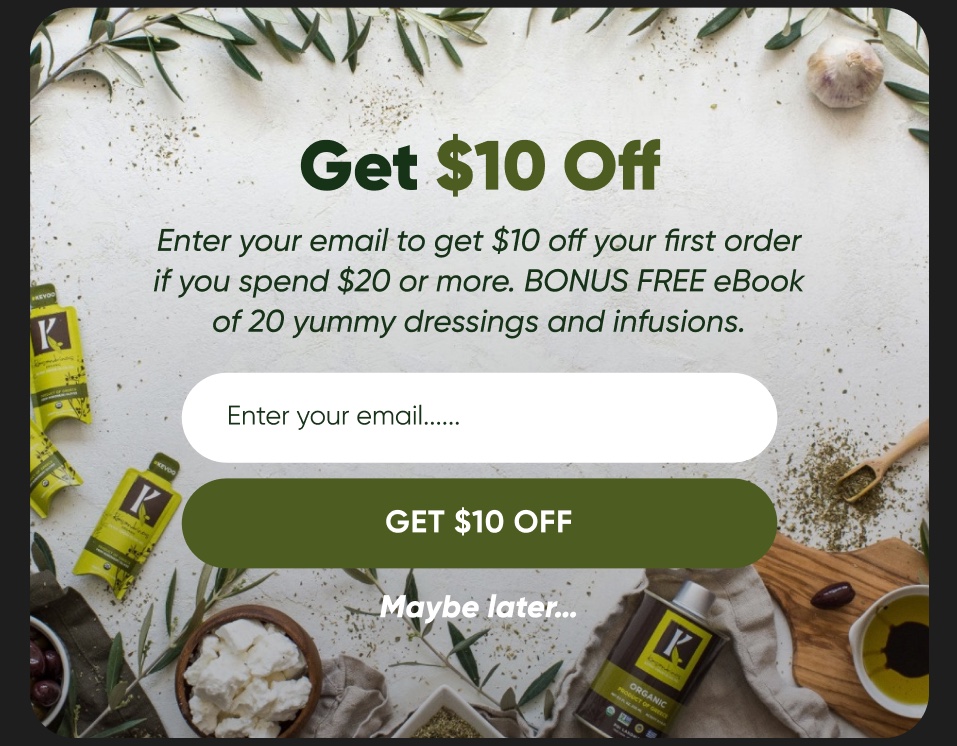
The long signup form is a segmentation wishlist
Email, birthday, phone number and product interest, all in one popup. That isn't a signup form, it's a segmentation wishlist, shown to somebody who's been on the site four seconds. They wanted a discount code. You asked for a date of birth, as if they were opening a bank account.
We took over an account running exactly that: a popup with four fields, converting at a mediocre rate. We stripped it back to email only and rebuilt the other three questions into later moments in the journey. Same data, same profiles. And the popup converted noticeably more of the people who saw it.
The offer didn't change. The creative didn't change. All that moved was where and when each question got asked. That ordering has a name, and it's ordinary conversion work, not a clever trick.
A popup earns the right to ask for one thing
A popup interrupts somebody mid browse, before they've given you any real signal about who they are or what they want. Asking for a phone number and a birthday at that moment is asking for trust you haven't earned. One ask matches the moment: an email address.
So strip it back to one field. No dropdown asking what they're shopping for, no date picker, no phone field with a country code selector for mobile visitors to give up on. Every field past email is a tax on your capture rate, and you pay it before the person has read a single email from you.
Email is the one thing you genuinely need on day zero, because it's what lets the welcome flow start proving value. Everything else can wait until that flow has done some of the persuading for you.
The phone number ask belongs inside the welcome flow
By the second or third email, an opener has told you something the popup never could: this person actually reads what you send. That's the moment to ask for a phone number. Not day zero, from a stranger still deciding whether you're worth the address they just typed.
Put the ask inside the flow instead of firing another box on site. A line in email two, offering the same offers over WhatsApp or SMS to anyone who drops their number, reads as an upgrade to a relationship that's already started. It reads nothing like a form gatekeeping a discount code.
A number collected off the back of real engagement is a warmer number too. They chose the channel instead of ticking a box to make a popup go away, so the opt outs come slower and the replies come faster.
Product interest belongs on the category page, not the form
Asking what are you interested in on a popup asks somebody to segment themselves before they've browsed anything. Most people skip the field or pick at random to get past it, and now there's a segment tag in Klaviyo that's confidently wrong. Bad data is worse than no data, because you'll act on it.
The better signal is behavioural. Somebody clicks into your skincare category, lingers, views a couple of products: they've answered the question without being asked. If you want it confirmed out loud, trigger a small prompt or a follow up email off that browse session, tied to the thing they just did.
A form field gets one shot at guessing and takes it before there's anything to go on. A behavioural trigger waits. By the time it asks, it's asking about something the person just did, not predicting who they might turn out to be.
The same questions land differently at different moments
Picture one brand running both versions. The wrong one asks for everything at the door and captures a fraction of the people who see it, with junk birthdays and lukewarm phone numbers attached to the few who push through. The right one asks for each thing at the first moment the person has proved they're worth asking.
| The ask | On the popup | Where it belongs |
|---|---|---|
| Email address | The one field that should be there | The popup, on its own |
| Birthday | Junk dates typed to get past the field | A welcome flow email, framed as a treat to come |
| Phone number | Abandoned at the country code selector | Email two or three, after an open, as an upgrade |
| Product interest | A cold guess made before any browsing | A prompt triggered by the category they just visited |
The volume difference at the top changes everything downstream. More addresses go into the welcome flow, so more people are still around by email two to be asked anything at all. It compounds because the top stayed wide, instead of narrowing before the flow ever got going.
Match the size of the ask to the size of the relationship
- Email at zero investment, the moment the popup fires
- Phone number once somebody has opened twice inside the welcome flow
- Product interest once somebody has clicked into a category and lingered
- Birthday once somebody believes your emails are worth getting on their day
That ladder is progressive profiling. Each question lands on a person who's already shown slightly more commitment than the last question needed, so completion holds instead of collapsing at the first hurdle. It isn't manners. It's matching the ask to the evidence.
The same test applies to any field you're tempted to bolt onto a popup, and there's always one more you could add. Ask which of them genuinely needs answering before the welcome flow has sent its first email. Usually none of them. Not yet, anyway.
Theo Tziapouras
Founder and strategy at Engage Commerce, the ecommerce agency for 7 and 8 figure DTC brands.
FAQs
What is progressive profiling in email marketing?
It's collecting subscriber data across several moments instead of one form. The signup ask stays at an email address, then the later questions, phone number, birthday, product interest, get asked inside flows or triggered by behaviour, each one timed for when the person has shown enough engagement to answer willingly.
Do fewer form fields really mean more signups?
Consistently, yes. Every extra field hands a visitor another reason to close the box, and on a phone a date picker or a country code selector is real friction. You aren't trading data for growth either, because the questions you take out can still be asked later, of people far more likely to answer them.
When should I ask subscribers for their phone number?
Once they've proved they read your emails, which usually means the second or third message of the welcome flow. Frame it as an optional upgrade, not a requirement. A number given at that point belongs to somebody who chose the channel, and that shows up later in fewer opt outs and better replies.
How do I collect birthdays without putting a field on the popup?
Ask inside the welcome flow or in a later campaign, and give a reason. A treat on the day is the honest one. One question put to a warm subscriber gets you real dates, where a popup field gets whatever gets somebody past the box fastest.
Ask for less at the door
The brands that know the most about their subscribers are usually the ones that asked for the least up front. They let the email address open the door, let the welcome flow earn the next question, and let behaviour answer the rest. Ask for less at the door, and ask for more once somebody's actually walked in.
Programme and calendar
How often to send, what to send when, and what retention costs to run.
You can still get customer emails from Amazon buyers, you just can't ask Amazon for them
The bridge off the marketplace is the box, not the storefront: an insert card with one job and a QR code that earns the scan.
Read it
Loyalty programme emails do the retention work your points widget can't
Sign-ups climb and the dashboard looks busy, but behaviour never changes. The emails around the programme do the work the widget cannot.
Read it
Your Meta ads landing page shouldn't be the homepage
Every click you buy is a promise made mid-scroll. One landing page per ad angle is how the promise gets kept.
Read itWould you rather this was just handled?
Bring your Klaviyo account and the thing annoying you most. We will tell you what we would fix first, before you spend anything.

Half an hour with Theo, our founder.
We're all about relationships built on trust, mutual respect and a shared vision for success. If that sounds like your vibe, let's make some waves together 🌊