Your Meta ads landing page shouldn't be the homepage
Every click you buy is a promise made mid-scroll. One landing page per ad angle is how the promise gets kept.


You watched a video about the one problem a product fixes, clicked, and landed on a homepage full of things you've never heard of. That isn't a bad ad. It's a bad handoff, and it's the most common way we watch paid social budget quietly disappear.

The ad did its job, then the page threw it away
You watched a short video about the one problem a product fixes. You clicked because it named your exact problem. Then you landed on a hero banner above a carousel of things you've never seen before, and you bounced almost instantly. Nothing about that click was wasted until the page loaded.
The homepage was built for somebody who already knows the brand and trusts it enough to browse. The person who just clicked is neither. They're mid-thought, holding one idea, and now they're being asked to work out again why they clicked at all. The ad made a promise. The homepage has never heard of it.
Nobody says this bit out loud in an ads review, but the ad did its job. It stopped somebody mid-scroll and made a promise sharp enough to earn the click. Everything that went wrong happened after the click landed. So another round of creative testing won't fix it.
One landing page per ad angle, not one per campaign
Every ad angle is a bet on one problem, framed one way. A hook about a skin barrier wrecked by over-exfoliating is a different conversation to clinically tested redness relief, even when both are true of the same product. Your visitor expects the page to carry on the exact conversation the ad started. Same sentence, same voice.
So the first headline on the landing page continues the ad's sentence. It never rebrands into the homepage line. If the ad promises to stop leggings rolling down, the page opens on some version of that same sentence, not on premium activewear designed for movement. Your visitor should read the first line and know they're in the right place, with no translation needed.
In practice that's one landing page per ad angle, not one strong page for the whole campaign. It's conversion rate optimisation work as much as paid social work, and it only happens when the two sit in the same room. One team briefing the other over Slack once a quarter? That never produces matched pages.
Build the page backwards from the hook, not forwards from the product
Under time pressure the instinct is to build one good page and point every ad at it. It feels efficient, right up until you compare click to add-to-cart by ad set and find one creative converting far better than another on the same offer and the same page. The page was never neutral. It matched one hook and ignored the other.
Start from the hook and work forward. Take the exact line or visual beat that earned the click and make it the first thing on the page, before the product shot and before the reviews carousel. If the ad is a founder explaining she built the cream because her own child kept reacting to other brands, the page opens in her voice with that story, not with a meet-the-founder panel three scrolls down.
Then make the call ad set by ad set. A problem-aware creative needs a page that agitates and resolves that problem before any product grid shows up. A demo-style creative needs specs, sizing and proof straight away, because that visitor wants evidence, not persuasion. Send both clicks to one page and you undersell to one group and oversell to the other, every single visit.
The welcome email has to remember what the ad said
Here's the bit almost everybody misses, brands who got the landing page right included. The eczema click lands on the eczema page, gets convinced and drops an email in for the offer. Then the welcome flow fires the same generic first email every subscriber gets. Same handoff mistake, second time round, made by the channel holding the best information.
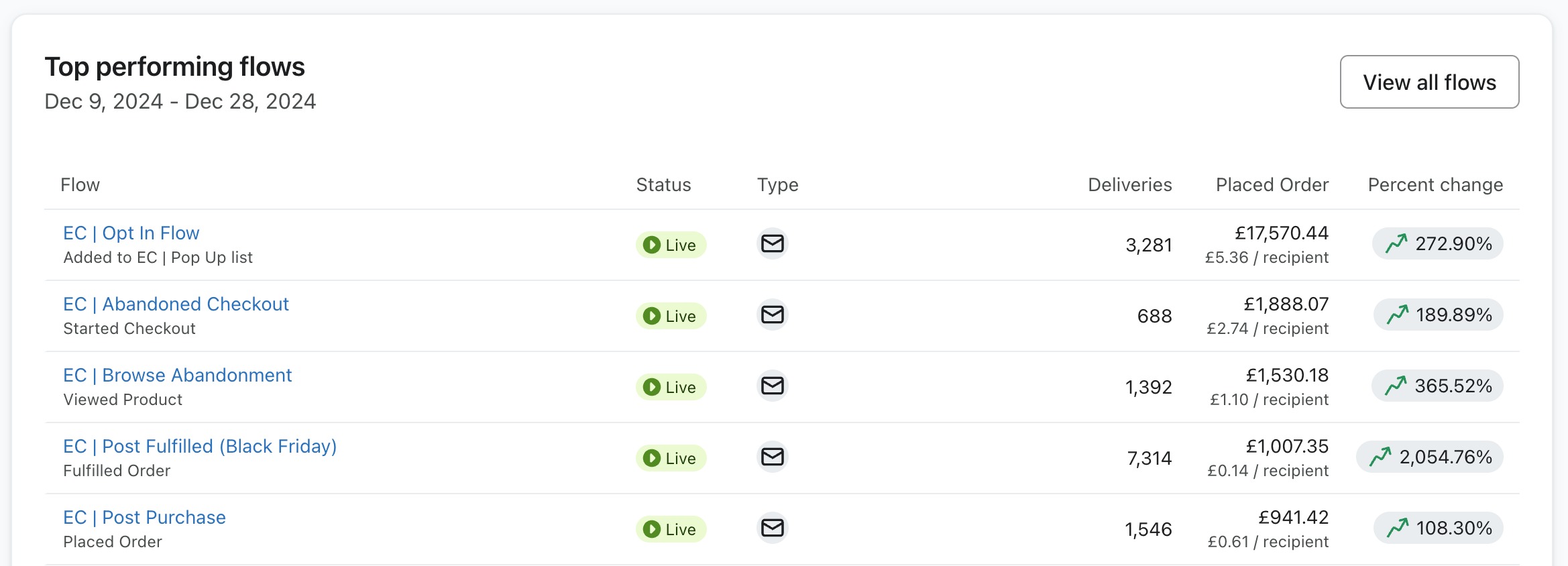
The join shows up in any flows report like that one. The opt-in flow fires off a list or a form, and whatever the form knew about that subscriber either travels with them or dies right there. Somebody who arrived through a specific ad angle has already told you what they care about. Email one should open on that, and your brand story can wait for email two.
Wiring it up means branching on the entry point. Use UTM parameters or a tagged form field to route people into a flow variant instead of just a discount variant. Google Ads hands you the same signal in a different shape through the search term. It's more setup than one flow for everyone, and it's ordinary email work once somebody owns it.
The check to run before any new ad set goes live
- The single specific claim or problem this creative leads with, written down in one sentence
- Whether the landing page's first headline says that same thing back in the visitor's language, not yours
- Whether the first fold answers the objection the ad just raised, before it shows anything else
- Whether a version of email one opens on this same angle, or every entry point gets the same welcome
- Whether anybody would notice if this ad's landing page were swapped for a different ad set's page
If nobody would notice the swap, every ad on the account is effectively landing on the same page. That's the gap this whole discipline exists to close, and it's the first thing we look for when we take over the email on an account running Meta ads. The same pattern turns up in the accounts we've rebuilt, again and again.
Treat it as a matching exercise, not a redesign project. The promise in the creative, the headline on the page and the first line of the follow-up flow should all say the same sentence to the same person. Get that right and the same spend on the same audience tends to convert differently, because the page underneath was finally built to answer what the ad promised.
Theo Tziapouras
Founder and strategy at Engage Commerce, the ecommerce agency for 7 and 8 figure DTC brands.
FAQs

Do I need a separate landing page for every Meta ad?
No, one per angle. Ads that share a hook can share a page, because the visitor turns up holding the same thought. The moment a creative leads with a different problem or a different framing, it's earned its own page, however similar the product underneath happens to be.
When is the homepage the right landing page for Meta ads?
For retargeting warm audiences who already know you, and for branded campaigns reaching people who searched for you by name. Those visitors arrive with context, so browsing is a fair next step. Cold prospecting traffic almost never qualifies, because the ad is the only context those visitors have.
How do I pass the ad angle into Klaviyo?
Tag the sign-up form, or capture the UTM parameters into profile properties when the subscriber is created. A conditional split at the top of the welcome flow then routes each entry point into its own opening email. The branches can merge back together after the first or second message.
Is a product page good enough for a Meta ad?
Sometimes. A demo-style creative that already showed the product in use can land on a strong product page, because that visitor wants specs and proof, not persuasion. A problem-led creative can't, because the product page starts at the solution before the visitor has seen their problem named.
The click bought a conversation, so have it
A Meta ad is permission to continue one specific thought in one specific head. A homepage can't do that, because it's built to say everything to everyone. The brands that win on paid social aren't the ones with the best creative. They're the ones whose landing page and first email keep the exact promise the ad made mid-scroll.
Programme and calendar
How often to send, what to send when, and what retention costs to run.
The email preview text length that survives an iPhone is shorter than you think
Two people on the same model of iPhone can read two different sentences from one campaign, and one of them stops mid-word.
Read it
How often should you send marketing texts? Let the first 30 days tell you
There is no ignore button on a text, only unsubscribe. The ceiling comes from your own opt-out curve, read send by send.
Read it
Most stores never capture emails from guest checkout, and they already paid for those clicks
Shopify collects an address on every guest order. What it never collects is permission, and the checkbox under the payment fields never gets it.
Read itWould you rather this was just handled?
Bring your Klaviyo account and the thing annoying you most. We will tell you what we would fix first, before you spend anything.

Half an hour with Theo, our founder.
We're all about relationships built on trust, mutual respect and a shared vision for success. If that sounds like your vibe, let's make some waves together 🌊