Klaviyo vs HubSpot for a Shopify brand: which one fits how you sell
HubSpot is built for a sales team working deals. Klaviyo is built for a shop that sells to people who never speak to anyone.


Look, this isn't really a fight between two email tools. One is a CRM with marketing bolted on and done well. The other is a customer database built around what people do in your shop. Which one you need depends on whether anyone at your company picks up the phone to close a sale.

Ask who closes the sale, then pick the tool
Here's the quick version. If your revenue comes through a checkout, with no human involved, Klaviyo fits the way you sell. If it comes through people, with quotes, calls and a pipeline, HubSpot does.
Most Shopify brands are firmly in the first camp. Some aren't. The ones with a trade arm, a wholesale team or big corporate orders often live in both, and that's where this question gets interesting.
We're a Klaviyo partner, so weigh this accordingly
We're an official Klaviyo partner. We benefit when brands pick it, and you should read every line below knowing that.
So here's the bit that costs us something. HubSpot is a very good product. For a business that sells through a sales team, it's the better choice, and we'd tell you that on a call. We just don't think most direct to consumer brands are that business.
A deal pipeline on one side, a shop's event stream on the other
Start with what each one was made to hold. HubSpot started as inbound marketing and grew into a full CRM: contacts, companies, deals, a sales pipeline and a service desk. Klaviyo started with online shops, and everything in it hangs off a profile and the events attached to it.
| Klaviyo | HubSpot | |
|---|---|---|
| Built for | Shops selling straight to customers | Teams selling through a pipeline |
| The core record | A profile and everything it did on the site | A contact linked to companies, deals and tickets |
| Shopify data | Orders, checkouts, products and on site browsing | Customers, products, orders and abandoned checkouts |
| Automation | Flows triggered by shop events | Workflows on the Professional tier and up |
| Best at | Sending the right email after a click or a purchase | Handing a lead to a salesperson at the right moment |
Both are honest descriptions. The trouble starts when a shop picks the tool built for a pipeline, then spends a year trying to make it think like a till.
What actually arrives in HubSpot from your Shopify store
HubSpot's own Shopify app is decent. According to HubSpot's Shopify integration guide, customers, products and companies sync both ways, while orders and abandoned checkouts come across from Shopify as order and cart records.
- Product variants don't sync, so a segment on size or colour needs a workaround
- Shopify metafields aren't supported by the sync app
- Custom field mapping needs a paid Data Hub tier
- Changes can take a few minutes to arrive, which is fine for a pipeline and slow for a cart email
- Product browsing isn't part of the sync at all
That last one matters most. HubSpot's tracking code records page views, and you can build on that. But the data a shop lives on is which product someone looked at, what it cost and what they did next. Klaviyo's Shopify data reference lists checkouts, orders, ordered products and fulfilments, with product views tracked on site on top.
Flows that react to what somebody just did in your shop
This is where the gap shows. A browse email, a cart reminder, a replenishment nudge and a winback all hang off something a customer did, or stopped doing. In Klaviyo each of those is a trigger you pick from a menu.
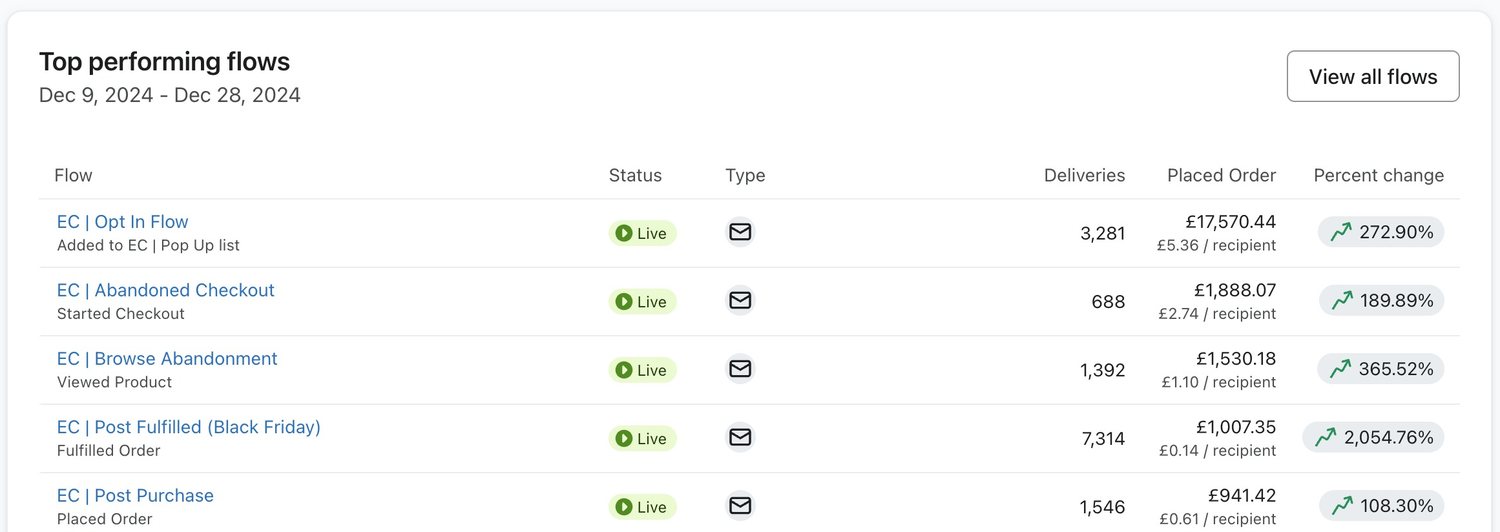
Every row there runs off a shop event: a sign up, a checkout, a viewed product, a fulfilment, an order. You can build some of it in HubSpot. You'll be building it by hand, and maintaining it by hand, and that's what most brands underestimate. The flow library is the full set we'd expect a shop to run.
Where HubSpot is honestly the better buy
We get it, some of you aren't pure direct to consumer. If any of these sound like your week, HubSpot earns its place.
- A sales team that works leads, books calls and sends quotes
- Trade or wholesale accounts where the buyer is a company, not a person
- Long buying cycles with several people signing off
- A service desk that needs the same record as sales
- Content and lead forms doing more work than the checkout
None of that is Klaviyo's job, and it doesn't pretend otherwise. A brand with a real B2B side that forces it all through an ecommerce email tool ends up with deals in a spreadsheet. That's worse.
Both charge for people, just counted differently
No prices here, they change too often. The shape matters more. HubSpot bills on marketing contacts, the ones you've flagged to market to, and you can store everyone else without paying for them.
Klaviyo bills on active profiles, anyone you're able to email, and suppressed profiles drop out of the count. Either way, a list full of people who never open costs you money. Clean it before you compare quotes.

When the answer is both, and how they talk to each other
Plenty of brands with a trade side end up here. HubSpot runs the pipeline, Klaviyo runs the shop email. Partner-built apps on HubSpot's marketplace pass contacts and deal changes into Klaviyo, and email engagement back onto the HubSpot record.
- Decide which system owns the customer record, and write it down
- Send consumer marketing from Klaviyo only, so nobody gets emailed twice
- Keep trade buyers out of consumer flows with one clear property
- Pass purchases to HubSpot so sales can see them before a call
- Check the sync monthly, because a sync can break without telling anyone
Two tools is more to look after. But it beats one tool doing a job it was never built for. If you want a hand with the Klaviyo side, here's what we do inside Klaviyo.
Theo Tziapouras
Founder and strategy at Engage Commerce, the ecommerce agency for 7 and 8 figure DTC brands.
FAQs

Is HubSpot good for Shopify stores?
It's good at what it's built for. HubSpot syncs Shopify customers, products, orders and abandoned checkouts, and it's excellent if you also run a sales team. For a store that sells only through the checkout, the event-driven flows a shop depends on are easier to build and keep running in Klaviyo.
Can I use Klaviyo and HubSpot together?
Yes. Partner-built apps on the HubSpot marketplace sync contacts and deal changes into Klaviyo and send email engagement back to HubSpot. Pick one system to own the customer record, and send consumer email from one place only, so nobody hears from you twice.
Is Klaviyo a CRM?
Not in the sales sense. It keeps a detailed profile of every customer and what they did in your shop, but it has no deal pipeline, no quotes and no sales tasks. If you need those, you need a CRM like HubSpot alongside it.
Should I move from HubSpot to Klaviyo?
Only if most of your revenue comes through the checkout and you can name the emails you can't build today. If HubSpot also runs your sales team, keep it and add Klaviyo for the shop, instead of ripping out the pipeline.
Pick the tool that matches how the money comes in
A checkout brand on HubSpot isn't doomed, and a sales-led business on Klaviyo isn't either. They're just working against the grain every day. Work out where your revenue actually comes from, pick the tool built for that, and spend the energy you saved on what you send.
Platforms compared
What you give up either way, and what a migration actually changes.

Klaviyo vs Omnisend for ecommerce email: what you are choosing between
One is a customer database that sends email. The other is an email tool that got good at ecommerce. Choose on that.
Read it
Email vs SMS marketing ecommerce: which channel to add next
Only one of these three charges you by the message. That one fact decides almost everything about how you use it.
Read it
A Mailchimp to Klaviyo migration: what breaks, and what to check first
The data moves in an afternoon. Consent, reputation and every automation you had running are the parts that take a month.
Read itWould you rather this was just handled?
Bring your Klaviyo account and the thing annoying you most. We will tell you what we would fix first, before you spend anything.

Half an hour with Theo, our founder.
We're all about relationships built on trust, mutual respect and a shared vision for success. If that sounds like your vibe, let's make some waves together 🌊