Klaviyo segments vs lists: which to use, and what breaks when you pick wrong
A list is a room people get put in. A segment is a question the database answers again every time you ask it.

The two look interchangeable in the interface and behave nothing alike at the moment it matters, which is when a flow decides whether to send. Use lists for how somebody arrived and segments for what they've done since, and most of the mess sorts itself out.

One is a room, the other is a question
A list is a container. Somebody gets put in it by an action, usually a form submit, a checkout tick or an import, and they stay there until something takes them out. Nothing about the list changes on its own.
A segment is a saved question. It holds a definition instead of people, and Klaviyo answers it continuously, so membership moves while you're asleep. You can't add somebody to a segment, and that single fact explains almost every mistake below.
What each one is actually for
The split we work to is simple enough to keep in your head. Lists record how a person arrived. Segments describe what they've done since.
| A list | A segment | |
|---|---|---|
| Membership | Fixed until something changes it | Recalculated continuously |
| How people join | A form, a checkout, an import, the API | By matching the definition |
| Good for | Consent, source, one-off imports | Behaviour, recency, value, exclusions |
| Flows | A dependable trigger | A trigger that can fire more than once |
| Campaigns | Everyone who ever joined | Everyone who currently qualifies |
Consent is the reason lists still matter. A list carries the record of what somebody agreed to and when, and a behavioural definition can't do that for you. The words for all of this sit in the glossary if you want them settled.
A list is a record of how somebody arrived
Most lists in a healthy account come from one place: the sign-up form on the site. The form writes to a named list, and that list is the honest record of the promise your shop made when it asked for the address.
The second one worth having is whatever the checkout writes to, because the promise there is different. Somebody buying a kettle agreed to hear from you while they were buying a kettle, and keeping that separate from the pop-up list is what lets you honour both without thinking about it.
So keep the number of lists small and name them after the source: the pop-up, the footer form, the competition, the wholesale enquiry. Name a list after a behaviour instead of a door and somebody will eventually treat it as if it updates itself. It doesn't.
What to trigger a flow on
A flow trigger is a moment, so it wants an object that describes a moment. Being added to a list is a moment. Matching a definition for the third time this month isn't.
- Somebody joins through a form: trigger on the list, because joining is the event
- Somebody browses, searches or starts a checkout: trigger on the event, not on an audience
- Somebody becomes valuable, lapsed or at risk: use a segment trigger, and check the re-entry setting
- Somebody should stop receiving the rest of the flow: that's a flow filter, not a different trigger
- Somebody has to be excluded entirely: build one suppression segment and use it everywhere
Segment triggers are useful and they bite. A loose definition lets people drift in and out, and each entry can start the sequence again, which is a strange way to send a first email. Tighten the definition before you loosen the flow. the flow library each name the trigger we build them on.
What to send a campaign to
Campaigns are the other way round. Send to segments, use lists only as a starting point, and treat the exclusion as part of the audience instead of an afterthought.
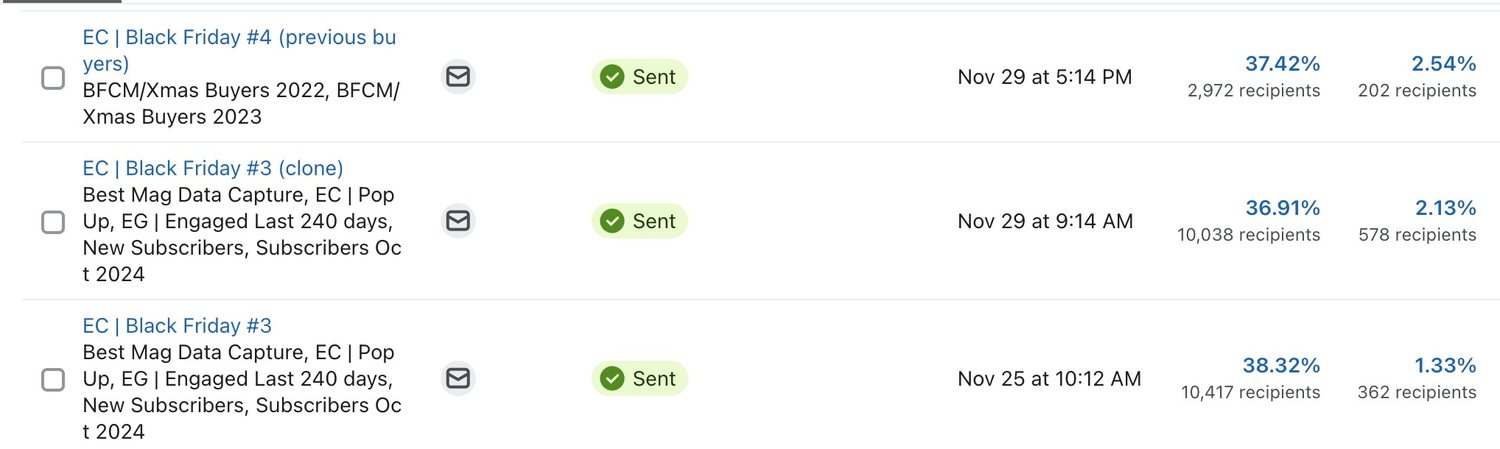
The audience names in those rows are doing the work. Sends went to recent buyers, to people who'd engaged in the last few months and to subscribers from a known month, not to one list called everyone.
That's also how a domain reputation survives a peak. Volume climbs because more segments qualify, not because somebody selected the whole file.
What breaks when you pick the wrong one
Four failures cover nearly everything we find in an account handover. An engaged list built by hand in March and never rebuilt. A welcome flow triggered on a segment loose enough that people re-enter it. A campaign sent to a list that only ever grows. And a suppression rule applied to one send instead of saved once.
Unsubscribing isn't a list-by-list matter in Klaviyo. It sets consent on the profile, so nobody can be quietly kept on a second list, and suppression belongs in a segment you can point every campaign at.
If you inherit an account, count the lists first. More than a handful usually means somebody has been building segments in the wrong place for a year, and untangling that is the first job. What we do inside Klaviyo starts here more often than it starts with design.
Theo Tziapouras
Founder and strategy at Engage Commerce, the ecommerce agency for 7 and 8 figure DTC brands.
FAQs

Can I turn a Klaviyo list into a segment?
Not directly, and you rarely want to. Build the segment with the definition you meant, keep the list as the record of how those people arrived, and point your campaigns at the segment. The list stays useful as evidence of consent even when nothing is sent to it.
Should a welcome flow be triggered by a list or a segment?
A list, almost always. Joining the list is the moment the reader is expecting a reply to, and it happens once. A segment trigger works for later flows, where the moment you care about is somebody becoming lapsed or valuable, not somebody arriving.
Do segments slow a Klaviyo account down?
Not in any way you'll notice at ecommerce volumes. What causes trouble is dozens of near-identical definitions nobody can tell apart, so whoever is writing a campaign picks whichever one sounds right. That's an organisation problem, not a performance one.
Does sending to a list rather than a segment hurt deliverability?
Indirectly, and it's the commonest way a good sender goes bad. A list keeps everybody who ever joined, including people who've ignored a year of emails, so sending to it repeatedly teaches the mailbox providers that your mail gets ignored. Segments let you send to the people who still want it.
How many lists should a Shopify store have?
Usually a handful: the sign-up form, the checkout consent, and anything with a genuinely different promise attached, like a wholesale enquiry. If the count is climbing, somebody is using lists to record behaviour, and behaviour belongs in a segment.
Few lists, many segments, named so a stranger can read them
The accounts that stay tidy have a handful of lists named after the doors people came through, and as many segments as the shop has questions worth asking. The accounts that go wrong have the reverse, and the tell is always the same: a list with a behavioural name that somebody built once and everybody now assumes is live. Name them so the next person can read them without asking you, because one day that person won't be able to.
Klaviyo mechanics
The settings that quietly decide what your flows do, from someone who has rebuilt a flow stack.

Klaviyo Smart Send Time is guessing: here's how to find your list's real send window
The model behind Smart Send Time learned its habits from opens Apple fired for you. Clicks and revenue know when your list really reads.
Read it
How to stop Klaviyo flows overlapping when cart and browse fire together
Cart and browse abandonment keep double emailing the same shopping session, and each flow reports healthy on its own. One list filter referees them.
Read it
Your Klaviyo predicted next order date already knows when they'll buy again
Klaviyo already calculates when each customer is due to buy again. Build winback and reminder triggers on that, not on an engagement window.
Read itWould you rather this was just handled?
Bring your Klaviyo account and the thing annoying you most. We will tell you what we would fix first, before you spend anything.

Half an hour with Theo, our founder.
We're all about relationships built on trust, mutual respect and a shared vision for success. If that sounds like your vibe, let's make some waves together 🌊