Your Klaviyo predicted next order date already knows when they'll buy again
Klaviyo already calculates when each customer is due to buy again. Build winback and reminder triggers on that, not on an engagement window.

Fire a reminder on the wrong day and you don't just waste the send. You teach the customer to buy from somebody else. Klaviyo is already working out when each person is due back, almost nobody wires that number into a flow, and the swap is smaller than it looks.
An engagement window is one clock strapped to every customer
Engaged in the last 30 days is a vanity metric in an operational costume. It proves somebody opened an email. It says nothing about when they're going to buy again, and it's still the default trigger sitting inside most winback and reminder flows.
Picture two customers who both clicked a campaign last month. One reorders coffee every six weeks like clockwork, the other reorders skincare every ten, and a thirty day engagement clock sends them the same nudge on the same day. One is already out of coffee and irritated you waited. The other still has half a jar of moisturiser and now thinks you're pushing product.
Same segment, same email, two wrong outcomes for opposite reasons. A wider window won't fix it. Thirty, sixty or ninety days is still one calendar boundary applied to people who don't buy on the same rhythm.
Set the reminder relative to each customer's own cadence
A standard winback fires on fixed checkpoints, the same static delays applied to the whole list. A cadence-built flow moves the checkpoint depending on who the customer is. A coffee customer whose average gap is 42 days gets the reminder around day 35, about four fifths of the way through their own cycle.
That landing point is the one decision that matters. Just past the three quarter mark of the customer's average gap is the usual starting point: early enough to beat the trip to the supermarket, late enough that they're not mid-bag and annoyed. Tune it per category once a few send cycles are in, because the starting logic holds whatever you sell.
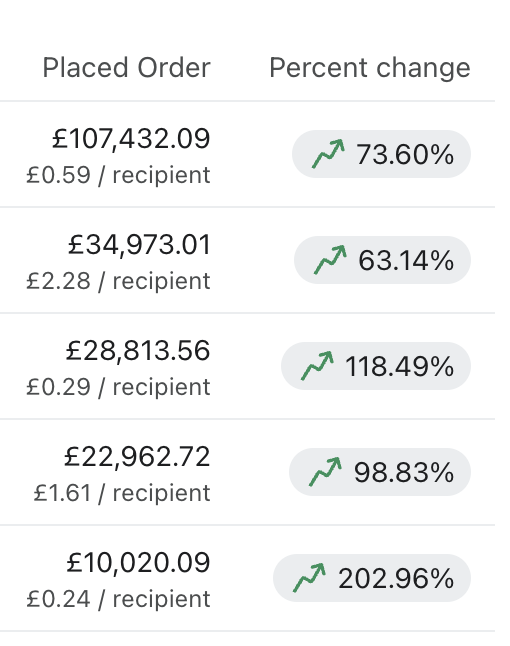
The payoff shows up in that column. Placed order revenue per recipient is the number that moves when the reminder lands inside the customer's own window, because the email stops being noise and starts being a well timed prompt. Judge the swap there. Not on opens.
Different products run on different clocks
Accepting the cadence argument and then building one flow for everybody is the next mistake. A single flow still makes editorial decisions, like how much urgency the subject line implies, and those decisions shouldn't be identical for a three week consumable and a four month one.
So split customers into bands on their actual average gap. Short cadence covers coffee, supplements and pet food. Medium covers skincare and haircare. Long covers fragrance, seasonal and gifting. The mechanism never changes, the trigger stays relative to each customer's own average, and only the threshold and the copy move between bands.
Tone follows the band. A short cadence reminder can be brisk and functional, along the lines of you're probably running low. Something somebody buys twice a year needs more warmth and a real reason to reorder now, because coffee urgency reads as pushy on fragrance.
Filter out the profiles whose average means nothing
Cadence data isn't clean for every customer, and a few edge cases will quietly wreck your timing if nothing filters them out. Run this checklist before the flow goes live, not after the send volumes already look wrong.
- First-time buyers have no average yet, so they belong in a separate post purchase track until a second order gives Klaviyo something to work with
- One-off gift buyers were never on a cadence, so exclude profiles with only one or two orders instead of treating them as overdue
- Churned customers carry a stale average, so cap the flow with a last order recency filter instead of letting it fire reminders forever
- Subscribers already have a cadence locked in, so exclude them at the segment level before the first send
The churned group matters most, because an average built from orders placed eighteen months ago means nothing now. Their next email should come from the winback flow, written for somebody who left, not somebody who's due. This checklist is one of the first jobs on the programmes we run, and it catches something almost every time.
Alex Gregoriades
Operations director at Engage Commerce, where he runs the accounts the writing comes out of.
FAQs
Where do I find the predicted next order date in Klaviyo?
On the customer profile, in the predictive analytics panel, next to average days between orders, churn risk and predicted lifetime value. It appears once the account has enough order history for the model to work with, and you can reference it in segment conditions and flow filters like any other profile property.
How accurate is Klaviyo's predicted next order date?
Accurate enough to beat a fixed calendar window, which is the real comparison. It's modelled on your own customers' order history, so it's strongest on regular consumable purchases and weakest on gifting and one-off categories. Treat it as a starting point and tune the timing per category as real send data comes back.
What if a customer has only ordered once?
There's no cadence to calculate from a single order, so keep first-time buyers out of cadence segments entirely. Give them a post purchase track with a sensible general nudge for the category, then move them onto cadence logic once a second order gives Klaviyo an average to work from.
Can a Klaviyo flow trigger on predicted next order date?
Yes. Date property triggers can fire a flow relative to the expected date of the next order, offset a little earlier so the email arrives before the customer runs out. The commoner build is a segment triggered flow comparing days since last order with average days between orders, which is easier to test and to reason about.
Swap the trigger, the data is already there
None of this needs new data. Average days between orders and predicted next order date are sitting on every profile with order history, whether you've ever pulled them into a segment or not. Ask where somebody is in their own buying cycle instead of whether they opened an email, and the reminder arrives when they're genuinely running low, not whenever the calendar says so.
Klaviyo mechanics
The settings that quietly decide what your flows do, from someone who has rebuilt a flow stack.
Your Klaviyo VIP segment is a badge while your best customers get first-timer emails
The spend report knows who your best customers are. The flow logic treats them like strangers. Closing that gap is the whole job.
Read it
Your Klaviyo AB test sample size was never big enough to crown that winner
The winner banner is built from a few dozen opens in a two hour window. Here is how to run a test worth trusting.
Read it
First name tokens are not personalisation, Klaviyo custom events are
The quiz answers, repeat views and preference data in your account are already enough to personalise every flow. Almost nobody asks them anything.
Read itWould you rather this was just handled?
Bring your Klaviyo account and the thing annoying you most. We will tell you what we would fix first, before you spend anything.

Half an hour with Theo, our founder.
We're all about relationships built on trust, mutual respect and a shared vision for success. If that sounds like your vibe, let's make some waves together 🌊