Klaviyo vs Shopify Email: what you give up either way
Shopify Email is fine until the day you need flow logic. That day turns up earlier than most brands expect.


Most Shopify brands start on Shopify Email because it's already there, and that's a fair place to start. The question isn't which tool is better. It's what your next twelve months need, and whether you're moving before your peak or during it.
One is a send button, the other is a customer database
Shopify Email is a send button with your catalogue attached. It builds a campaign inside admin, pulls in your products and your branding, and posts it to a Shopify customer segment. For a monthly newsletter that's genuinely all you need.
Klaviyo is a database with a send button attached. It keeps a profile for every person who's touched the shop, watches what that profile does, and triggers on the behaviour instead of the calendar.
Every difference below comes out of that one, and so does the cost of moving. You're not swapping a sender. You're moving where your customer data lives.
The line is flow logic, and brands cross it without noticing
Shopify Flow can send an email, wait, and check a condition. It's better than anyone who last looked at it years ago assumes. Where it struggles is the fiddly middle. Several splits in one journey. A different message for a first order and a fourth, and any way of seeing which of those splits earned anything.
| Shopify Email | Klaviyo | |
|---|---|---|
| Where the data sits | Your Shopify customer records | A profile per person with their events attached |
| Sending | Campaigns from admin | Campaigns, plus flows triggered by behaviour |
| Automation | Shopify Flow, with waits and conditions | Flows with splits, filters and per message reporting |
| Sign-up forms | Shopify Forms, a separate free app | Forms in the same account as the sending |
| Reporting | Sends, opens, clicks and revenue per campaign | The same, plus revenue per recipient and per flow |
| Priced on | The emails you send | The profiles you keep |
If your programme is a newsletter and one welcome email, none of that matters yet. If you're sketching something that behaves differently for a lapsed customer than for a first time buyer, you've already crossed the line. The rest is admin.
What you get once the profiles are all in one place
The useful part isn't the flow builder. Every platform has a version of that now. It's that a segment, a form, a flow and a report all read the same profile, so a rule you write once holds everywhere it's relevant.
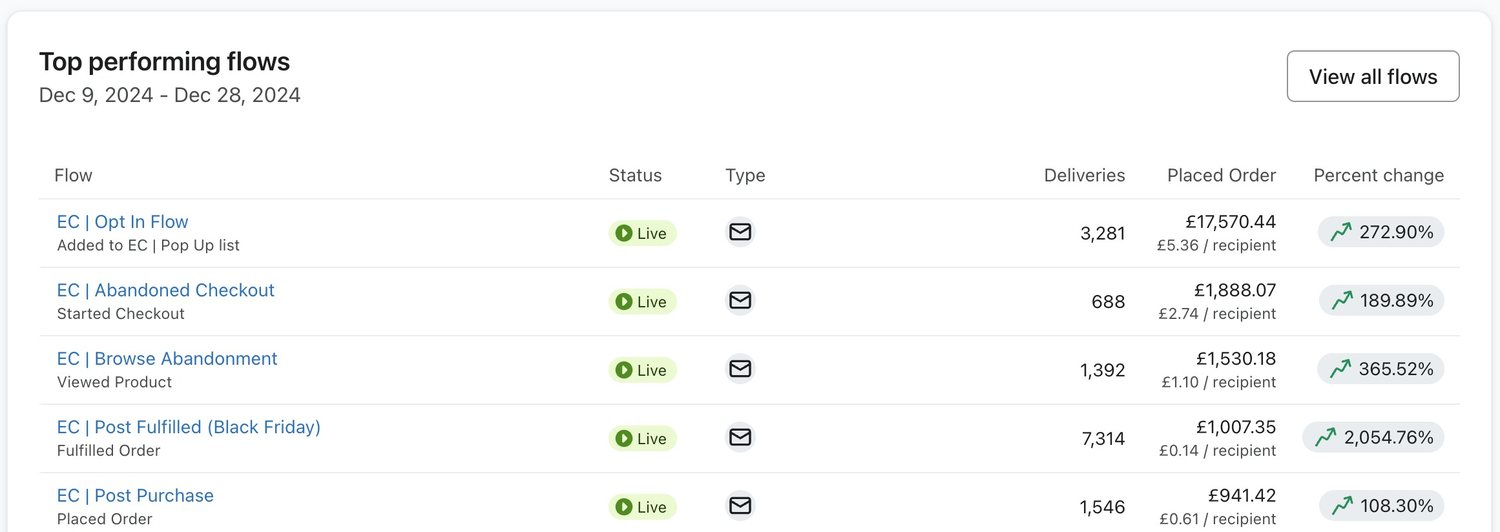
Each row there is a flow with its trigger named underneath it: started checkout, viewed product, fulfilled order. That's the level a growing Shopify brand ends up wanting, and the flow library is the shape it usually settles into.
You inherit the dull machinery that keeps you delivered, too: suppression that behaves, smart sending, and a deliverability view that tells you when to stop. See what we do inside Klaviyo for the version with our hands on it.
The costs nobody mentions when they tell you to move
Agencies tend to skip this half, and we've been guilty of it. A platform move costs a fortnight of somebody's attention. It also costs you the templates.
- A second system to keep in step with Shopify, and a sync that occasionally wants looking at
- A bill that grows with the size of your list, not with how much you send to it
- Every template rebuilt once, because the Shopify Email designer doesn't come with you
- Discount codes, embedded forms and any app that fed the old list, all pointed somewhere new
- A month of nobody being quite sure which system sent what, unless somebody writes it down
None of that's a reason to stay. It's a reason to move in February instead of October, with the list cleaned before anything is imported.
Where the two really diverge is the sign-up form
Shopify Forms is free, it does pop-ups, and it'll collect an address perfectly well. What it won't do is decide which offer a returning customer sees, or hold on to something a person typed so a flow can use it three days later.
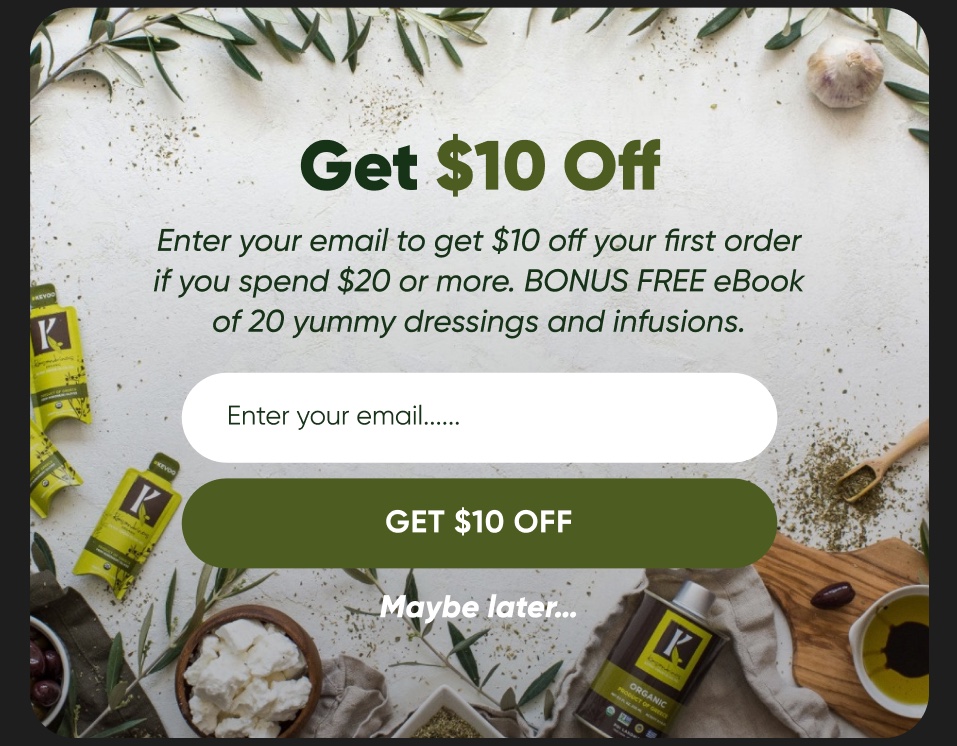
That pop-up is doing two jobs at once. Collecting the address, and setting the terms of the first email. When the form and the flow live in one account, the offer in the pop-up and the offer in the welcome email can't drift apart. That drift is the commonest broken thing we find on a takeover.
How to tell which side of the line you're on this year
- Count the marketing emails you sent last month that weren't a newsletter. If the answer is none, stay where you are
- Look at your traffic, because flows need people arriving and browsing before they have anything to fire on
- Write down what you'd build first if it were possible, then check whether Shopify Flow can hold it
- Find your peak in the calendar and take the migration nowhere near it
- Move the list, the forms and the automations together, not one at a time
We build in Klaviyo, so read this as an interested party's answer. It's still what we tell brands who aren't ready. Keep sending the newsletter, spend the money getting more of the right people onto the list, and move when there's something worth building. The case studies are all accounts where there was.
Theo Tziapouras
Founder and strategy at Engage Commerce, the ecommerce agency for 7 and 8 figure DTC brands.
FAQs

Do my order confirmation emails move to Klaviyo?
Not unless you move them deliberately. Order confirmations, shipping updates and password resets are Shopify notifications and they stay in Shopify by default. Some brands rebuild them in Klaviyo later for the design and the reporting, and that's a separate project from your marketing email.
Can I run Shopify Email and Klaviyo at the same time?
You can, and it usually ends badly. Two senders means two suppression lists, two sets of reporting and a real chance of somebody getting the same offer twice before lunch. Run both for a fortnight during a move if you have to, then turn one off and mean it.
Is Shopify Email good enough for a small shop?
For plenty of shops, yes. If you send a newsletter, run one welcome email and your traffic is still modest, the tool isn't the thing limiting you. Spend the money on list growth and the product pages, and come back to the question when there are enough people arriving to automate against.
What actually breaks during a migration?
Forms and consent records, usually. The embedded form on the site keeps writing to the old list, historical unsubscribes vanish if the suppression file isn't imported first, and discount codes attached to old automations quietly stop being issued. Check those three before you switch anything off.
When is the worst time to switch platform?
The weeks either side of your peak. A new sending setup wants a few quiet weeks of clean sending before mailbox providers trust it, and Black Friday is when your list is at its largest and least forgiving. Move in a dull month, and let the flows run for a while first.
The platform is rarely the thing holding a shop back
A brand sending one campaign a fortnight won't sell more because the campaign came out of a better tool. It sells more when somebody decides what the first three months after a first order should say, then builds it. Klaviyo makes that easier to build and much easier to measure. Worth paying for, once you've got something to build.
Platforms compared
What you give up either way, and what a migration actually changes.

Klaviyo vs Omnisend for ecommerce email: what you are choosing between
One is a customer database that sends email. The other is an email tool that got good at ecommerce. Choose on that.
Read it
Email vs SMS marketing ecommerce: which channel to add next
Only one of these three charges you by the message. That one fact decides almost everything about how you use it.
Read it
A Mailchimp to Klaviyo migration: what breaks, and what to check first
The data moves in an afternoon. Consent, reputation and every automation you had running are the parts that take a month.
Read itWould you rather this was just handled?
Bring your Klaviyo account and the thing annoying you most. We will tell you what we would fix first, before you spend anything.

Half an hour with Theo, our founder.
We're all about relationships built on trust, mutual respect and a shared vision for success. If that sounds like your vibe, let's make some waves together 🌊