How often should you send marketing emails, and how to find your own answer
There is no correct number. There is a curve, and your own list will tell you where it turns.


Anyone who answers this with a number is guessing about your list. The accounts we take over are rarely sending too much. They're sending the same thing to everybody, which looks like too much from the inbox and reads like too little in the reporting.
Why a number is the wrong answer
Two brands with the same list size can sit at completely different cadences and both be right. A weekly recipe letter and a twice yearly furniture sale aren't the same relationship, and no rule of thumb holds both.
The right cadence is a result you measure, not a number you pick. So the useful version of the question is narrower: what would tell me I'd gone too far, and am I watching it.
It depends on what you send as much as how often. A brand with something to say every week can hold a schedule that would exhaust a brand with nothing but offers. An unsubscribe is a judgement on the last email, not on the calendar behind it.
The three things that actually set the cadence
- The unsubscribe rate per send, which is your audience telling you politely
- The complaint rate, which is the same message delivered to the mailbox provider instead of to you
- Revenue per recipient, which falls first when you're sending to people who didn't want it
- Underneath all three, the trend and never one single send, because one bad Tuesday isn't a signal
Send more. Watch those three across a month. When unsubscribes and complaints start climbing together, or the per recipient number falls while total revenue rises, you've found the edge of the curve for that audience.
Read all of it per segment, never in total. An average across the whole file hides the group that's quietly furious, and by the time the total moves you've already taught a mailbox provider to expect complaints from your domain.
Sending more is not usually what breaks a list
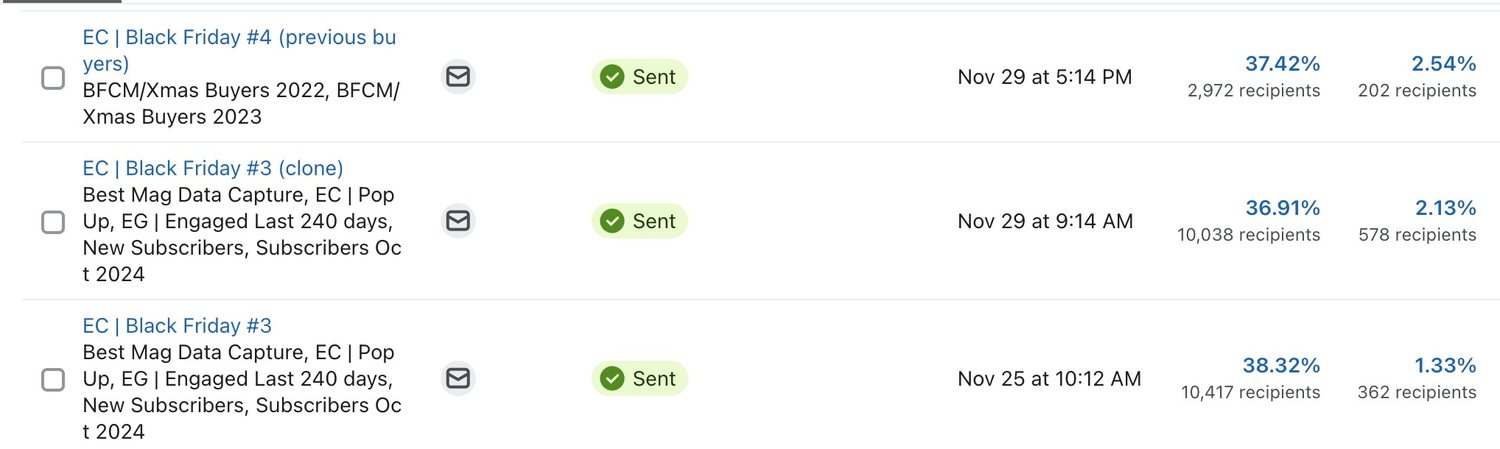
That's the shape we see most often. Volume rose, the audience for each send got more deliberate, and the engagement numbers improved while the calendar filled up.
Look at the segment names in that account, not the send times. Recent buyers, people who engaged in the last few months, new subscribers. Nobody there was sending to a list called everyone twice a week and hoping.
Cut the audience before you cut the calendar
The instinct when complaints rise is to send less to everybody. It works, in the sense that a smaller programme annoys fewer people. It also costs you the customers who wanted to hear from you every week.

The better move is to hold the calendar and change who gets what. Engaged buyers take the full schedule, the quieter half gets the two or three sends a month that matter, and people who've ignored you for a season come off the campaign list entirely.
It's also the cheapest change on the list. No new creative, no new offer, no extra sends. Only a decision about who is on each one, and it usually shows in the numbers inside a month.
The complaint rate is a hard ceiling, not a soft one
Bulk senders now have published requirements to meet, and complaint rates are part of them. Google sets out what it expects in its email sender guidelines, and the threshold is low enough that a handful of irritated recipients on a big send is a real problem.
So frequency isn't only a taste question. Past a certain point it becomes a deliverability question, and the punishment lands on every email you send afterwards, including the ones people were waiting for.
Seasonal categories feel this hardest, because the temptation is to email the whole file in the six weeks that matter. Homeware brands are where we see it most, and the fix never changes: more sends, narrower audiences, sooner.
A method you can run yourself this quarter
- Write down what you send now, to whom, and what each send is for
- Split the list by recency of engagement, not by who bought what
- Add one send a week to the engaged segment only, and leave the rest of the programme alone
- Watch unsubscribes, complaints and revenue per recipient for a month, by segment and never in total
- Hold the new cadence if the numbers held, and roll it out to the next segment down
- Stop widening the moment complaints move, and go back a step rather than trying to write your way out of it
Run that twice and you'll have an answer built out of your own list instead of somebody's blog post. It's also the point where the calendar stops being a monthly argument. How we build email systems is this method with the flows underneath it.
Theo Tziapouras
Founder and strategy at Engage Commerce, the ecommerce agency for 7 and 8 figure DTC brands.
FAQs

How many marketing emails a week is too many?
There's no number that holds across brands. Too many is the point where unsubscribes and complaints climb together, or where revenue per recipient falls while total revenue rises. On an engaged segment that point sits further out than most brands expect, and on a stale list it arrives immediately.
Will sending fewer emails improve deliverability?
Sometimes, and it's a blunt instrument. Sending less to everybody hides the problem, while sending the same amount to people who actually engage fixes it. If complaints are the issue, the audience is nearly always the cause, not the calendar.
Do automated flows count towards how often I send?
They count in the inbox, which is the only place it matters. Somebody in a welcome series who also gets three campaigns that week has heard from you a lot. Use smart sending or a flow filter so the automation and the calendar aren't talking over each other.
Is there a best day or time to send?
Less than the industry pretends. Test it if you want to, but that effect is small next to who you sent it to and whether the email was worth opening. Pick times that suit your customers, keep them consistent enough to become a habit, and spend the attention you saved on the segments instead.
Should I let subscribers choose how often they hear from me?
A preference centre is worth having once you've enough to offer that the choices are real. Before that it just adds a form nobody fills in. The cheaper version is an easy way to hear from you less, offered on the unsubscribe page, which keeps people you'd otherwise lose completely.
Frequency is an audience decision wearing a calendar costume
Almost every brand that asks us how often to send is really asking whether it can send more without being punished for it. Usually yes, and only to some of the list. Get the segments right and the cadence question answers itself, one audience at a time, with the numbers to show anybody in the business who's nervous about it.
Programme and calendar
How often to send, what to send when, and what retention costs to run.

A Black Friday email marketing plan for Shopify brands, week by week
The work that decides Black Friday happens in September. What to do, in the order it has to happen.
Read it
What a Black Friday countdown email is allowed to count
A countdown is a promise with a clock on it. Count down to something real, end when you said, and the urgency works.
Read it
Christmas email marketing for ecommerce starts the day Black Friday ends
Christmas isn't Black Friday with tinsel on. Different buyer, a hard delivery deadline, and a quiet week after that most brands waste.
Read itWould you rather this was just handled?
Bring your Klaviyo account and the thing annoying you most. We will tell you what we would fix first, before you spend anything.

Half an hour with Theo, our founder.
We're all about relationships built on trust, mutual respect and a shared vision for success. If that sounds like your vibe, let's make some waves together 🌊