Why are my emails going to spam, and what to check first
A diagnosis order that finds the fault: authentication, then the list, then the sending pattern, then the content.

Almost nobody finds the fault by rewriting the subject line, because the subject line is almost never the fault. Work down this list instead, and stop at the first thing that's wrong.
Spam is a verdict on you, not a setting on the send
Let's face it: there's no spam switch in Klaviyo and nothing to turn off in Shopify. Where an email lands is a decision the mailbox provider makes about your domain, on that day, for that reader. Gmail and Outlook are scoring the sender, not the send.
So the usual first move fails. People rewrite the subject line, because the subject line is the part they can see. Authentication and list quality decide it far more often. Both are duller.
The order below is the one we use on an account we've just taken over. It runs by how often the fault is actually there, so you start with the thing most likely to be broken.
Start with SPF, DKIM and DMARC on your own domain
If the sending domain isn't authenticated, nothing else you do matters. Google and Yahoo both require authentication from bulk senders, and Google publishes the current requirements in its email sender guidelines. An unauthenticated email from a real brand looks exactly like an unauthenticated email from somebody pretending to be that brand.
This is a DNS job, not a Klaviyo job. Klaviyo generates the records. Then somebody with access to the domain has to publish them, and that person is usually nowhere near the room where the problem is being discussed. It's the single most common reason a fix takes three weeks instead of an afternoon.
- A dedicated sending domain, so you're not sharing a reputation with strangers
- SPF and DKIM published on that domain, and passing on a real send, not on a test
- A DMARC record with a policy on it, not the p=none placeholder left over from setup
- A from address on the same domain as the shop
- Nothing else sending as you and forgotten about, such as an old review tool or a helpdesk
Check this before you touch anything else. If one of those five is wrong, fix it and send again before you form any other theory about what happened. See what we do inside Klaviyo if you'd rather not.
Then look at who you've been sending to
Mailbox providers watch what happens after delivery. Addresses that bounce, addresses that never open anything, addresses that were never really yours: they all push the score down, and they do it quietly.
You already know where these came from. A competition list, a file imported from an old platform, or a segment of everybody who has ever given you an address. None of them are malicious. All of them are full of dead addresses and people who don't remember you.
The fix is a sunset rule and a suppression habit. Stop sending to people who haven't engaged in months, and let them go instead of keeping them for the list count. If some of them are worth one more try, that's what the winback flow is for, and it goes to a segment, never to everybody.
Volume, cadence and the send that changed everything
A domain that's spent the year emailing a small engaged segment, then emails the entire list on the Friday before Black Friday, has announced that something changed. Filters treat sudden change as a signal. For spammers it usually is.
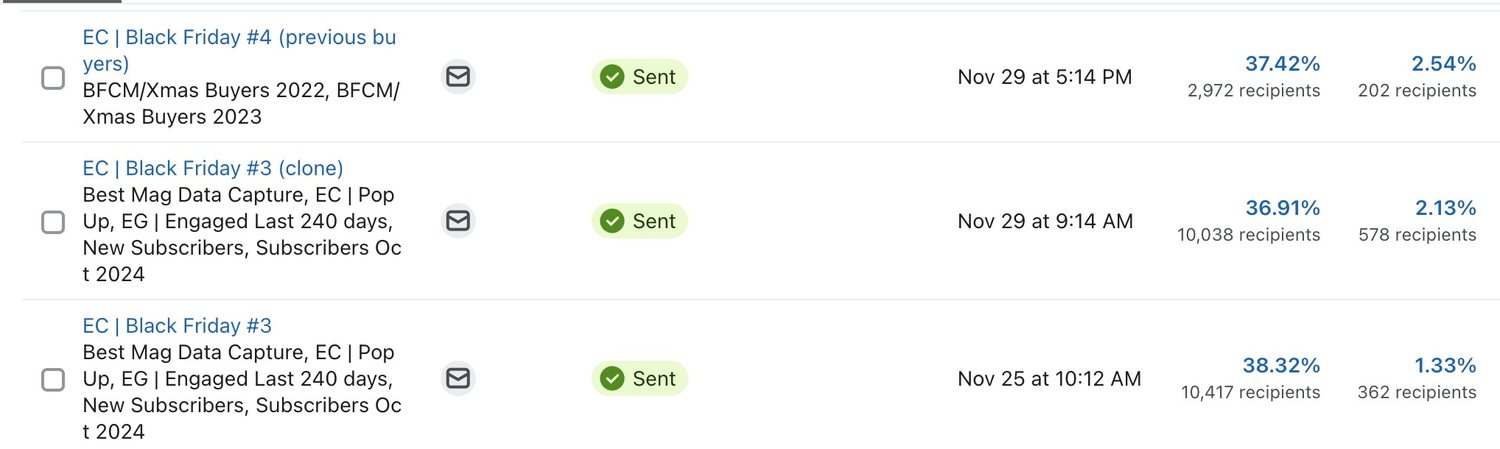
The segment names in that account are doing the work. Sends went to recent buyers and to people who'd engaged in the last few months, not to one list called everyone, and the volume climbed instead of jumping.
Same goes for a new domain. Warming means starting with the people most likely to open, then adding volume over days. Not sending the first campaign to the whole file because the platform let you.
What the content actually changes, and what it doesn't
Trigger words are mostly folklore. The word free in a subject line won't send you to spam on its own, and no filter in 2026 is counting exclamation marks. What content does change is whether people engage, and engagement is what the score is made of.
| Signal | Who controls it | What moves it |
|---|---|---|
| Authentication | You, in DNS | Publishing SPF, DKIM and DMARC on your own sending domain |
| Reputation | The mailbox provider | Months of bounces, complaints and engagement, not one send |
| Complaints | Your reader | Sending to people who did not ask, or too often |
| Engagement | Your reader | Whether the email was worth opening, replying to or clicking |
| Content | You, in the email | Image-only emails, link shorteners and a from name nobody recognises |

One content rule does hold. An email that's a single image with no text, sent from a name the reader doesn't recognise, through a link shortener, is doing three suspicious things at once. Any one of them is survivable. All three together aren't.
The order to work in, and when to stop
- Confirm the sending domain is yours and that SPF, DKIM and DMARC are published and passing
- Send yourself a real campaign and read the headers, instead of trusting a preview tool
- Look at where the addresses came from, and suppress the ones that have never engaged
- Check the last few sends for a volume jump or a new segment nobody warmed up to
- Only now look at the email itself: the from name, the image to text balance and the links
- Give it two or three weeks of clean sending before you judge whether it worked
Stop at the first thing that's wrong and fix it properly. Deliverability recovers slowly, and it recovers on evidence. Change five things at once and you'll never know which one mattered.
Been through all six and it's still happening? Then the problem is older than the current campaign, and it's worth reading the Rebel Aromas case study, where the fix took a rebuild, not a setting.
Theo Tziapouras
Founder and strategy at Engage Commerce, the ecommerce agency for 7 and 8 figure DTC brands.
FAQs

How long does it take to get out of spam?
Weeks, not days. Authentication takes effect on the next send, but reputation gets rebuilt by sending clean mail to people who want it, and the mailbox providers want to see that pattern hold before they change their mind. Rush it with a big send and you undo the work.
Do I need a dedicated IP address?
Most Shopify brands don't. A dedicated IP has to be warmed and kept warm by consistent volume, and a brand sending a few campaigns a week is usually better off on a shared pool with good neighbours. For almost everyone we work with, the domain reputation matters more than the IP.
Will sending fewer emails fix it?
Sometimes, but it's a blunt instrument. Sending less to everybody hides the problem; sending the same amount to people who actually engage fixes it. Cut the audience before you cut the calendar.
Can I test where my emails land before I send?
Seed tests and inbox placement tools give you a rough read, and they're worth running before a big campaign. Treat them as an indicator, not a verdict: they use their own seed accounts, not your customers' inboxes, and the two don't always agree.
Deliverability is boring, and that is the point
Nobody wants to spend a Tuesday in DNS records. But the brands that stay in the inbox are the ones who did it once, properly, then kept their list clean and their sending honest. Everything else in email sits on top of that. It's why we start every account here instead of with a campaign calendar.
Deliverability and UK consent
Getting into the inbox, and staying inside UK GDPR and PECR while you do it.

UK GDPR email marketing consent: what a lawful sign-up looks like
What the ICO expects from an ecommerce sign-up form, written by people who configure them rather than people who argue about them afterwards.
Read it
The Gmail and Yahoo bulk sender requirements are not why you are in spam
The rules only enforce what good senders already did. If spam placement arrived after February 2024, the fault was in the account long before.
Read it
Your email list warm up for Black Friday starts in September, not November
Inbox providers grade November on what you sent in September and October. A list that went quiet needs six weeks of staged re-warming first.
Read itWould you rather this was just handled?
Bring your Klaviyo account and the thing annoying you most. We will tell you what we would fix first, before you spend anything.

Half an hour with Theo, our founder.
We're all about relationships built on trust, mutual respect and a shared vision for success. If that sounds like your vibe, let's make some waves together 🌊