Your email list after Black Friday is not the list you had in October
A meaningful share of the November sign-ups came for a code or a gift. January starts by finding out who is still listening.


Pull up your subscriber count from the start of November and compare it with the start of January. It went up, probably by a lot. The question nobody asks in December is who actually joined in that window, and whether they want anything to do with you now the code has expired and the gift is wrapped.

December added names, but it did not add an audience
The sign-ups arrived in one loud month, for reasons that had little to do with the brand. A meaningful chunk of a typical BFCM bump is gift buyers, people shopping for somebody else's Christmas, not their own. Another chunk is code hunters, in for the discount and gone the moment it expired.
A smaller slice are genuinely good future customers who happened to arrive during the noisiest weeks of the year. All three groups now sit in the same list as your core audience, the people who were opening and clicking in October before any of this started. The count went up. The list changed shape.
Send the standard evergreen calendar back into that mixed pile and January will look soft, and the season will take the blame. The problem isn't that January is quiet. The problem is who's on the list.
Run the re-permission pass before any flow goes back on
Before the promotional calendar resumes, and before a single welcome back campaign fires, send one honest campaign to everybody who joined between your BFCM start date and the end of December. Not the whole list. Just that cohort. The subject line should say exactly what it is, something like still want these in your inbox.
No discount attached, because a code just re-triggers the same bargain hunting that built the problem. This campaign has one job: surface any sign that somebody is still paying attention. Selling can wait until you know who you're selling to.
Think of it as the back half of the warm-up you ran before peak. The warm-up earned the inbox for November. The re-permission pass decides who keeps hearing from you in the new year.
Read the response on clicks and site activity, never on opens
An open on this campaign is weak evidence, and not only because gift buyers open out of curiosity then do nothing. Apple's Mail Privacy Protection preloads images, so a recorded open stopped meaning a human being years ago. Build the resegmentation logic on actions a machine can't fake.
- A click through to the site, on the pass or anything after it
- A reply, even a short one
- Browse or search activity in the days that follow
- An order, which settles the question on its own
Segment on opens alone and you keep most of the dead weight while the list looks healthier than it is. Clicks are scarcer, and that's the point. A smaller segment you can trust beats a bigger one you can't.
Split the cohort three ways instead of folding it back in
Once the pass has run its course, split the BFCM cohort three ways instead of folding the survivors into the main list and forgetting the rest. Each group earns a different treatment, because each one told you something different.
| Segment | Who lands in it | What happens next |
|---|---|---|
| Responders | Clicked, replied, or browsed the site after the pass | Straight back into the core flows, treated like anyone else on the list |
| Slow nurture | Opened but did nothing else, or stayed silent without unsubscribing or complaining | A lower-frequency track of genuinely useful content while you watch what they do |
| Dead weight | No response to the pass, and nothing since the original discount click | Suppressed from the calendar, then retired properly |
Dead weight stays on the list for record keeping, but it comes off the calendar entirely. Give those profiles a proper ending instead of an indefinite silence, and put the once-valuable names that have genuinely lapsed through the winback flow instead, sent to a segment and never to everybody. Mailing an evergreen calendar to people who'll never open again is the most common reason January falls off a cliff.
Rebuild the flow entries around the audience that is left
Your flows were built and tuned against the audience you had in October, and that audience no longer exists in the same shape. Most brands skip this step because it feels like extra work for a slow month. It's the step that decides whether the slow month repeats in February.
The welcome flow is the clearest example. Copy written for somebody who found you organically falls flat on somebody who joined for a one-time code and is only now getting a first welcome, weeks late, because the queue backed up over peak. Check the entry timing, then either speed it up or write a variant that owns the gap honestly.
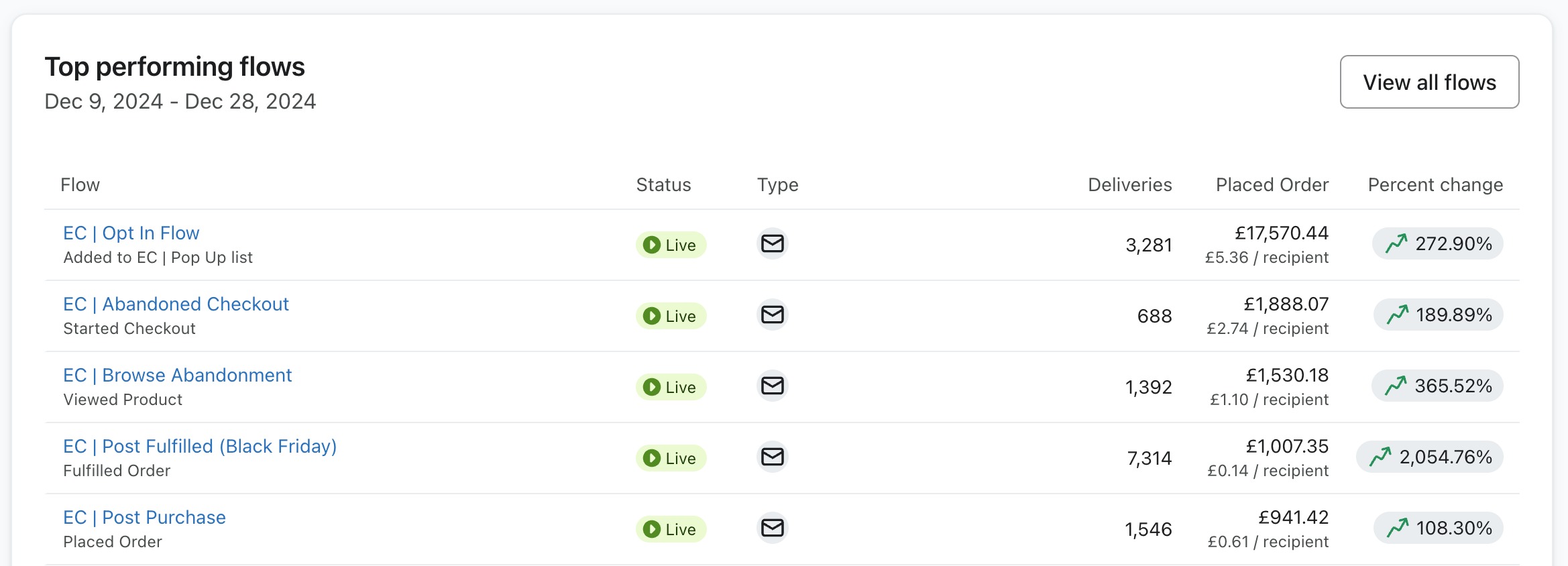
Same logic applies to post-purchase if a chunk of the November and December orders were gifts. An email asking how somebody is enjoying their new product lands strangely with the person who bought it for their sister. Tag gift orders at checkout where the platform allows it, and route them into a variant that asks about the gifting experience instead.
Finish the sorting before the calendar switches back on
The mechanism only works in sequence. Switch the evergreen calendar on in the first week of January while the pass runs alongside it, and the response data is contaminated by people reacting to campaigns they should never have received. You end up sorting the cohort on noise.
Week one is the re-permission send and the waiting. Week two is building the three segments, confirming the suppressions are applied at platform level and not tagged and forgotten, and rewriting the flow entries that need it. Only after that does anything go back to full frequency.
So the first two weeks of January look quieter than usual. That's fine. On the accounts we run, the brands that treat January as a rebuild month outperform the ones that treat it as a rest month. Resting through it is usually just avoiding the work and calling it a strategy.
Alex Gregoriades
Operations director at Engage Commerce, where he runs the accounts the writing comes out of.
FAQs

Should I delete unengaged subscribers after Black Friday?
Not straight away. Suppress them from regular sends first, run the re-permission pass, and let the genuinely silent leave through a proper sunset process once the evidence is in. Delete on day one and you throw away the signal that tells a gift buyer from a lapsed customer. Suppression protects deliverability just as well.
How long should I wait before emailing my full list in January?
About two weeks. The first week is the re-permission send to the BFCM cohort and the waiting that follows, and the second is building the segments and checking the suppressions actually apply at platform level. The rest of the list, the people who were engaged before November, can carry on at their normal cadence throughout.
Do gift buyers ever become real customers?
Some do, but not by being treated as the person who owns the product. Ask about the gifting experience, invite them to buy for themselves when the moment is honest, and accept that plenty were only ever passing through. The ones who convert do it because the brand noticed the difference.
Why do open rates drop in January after a big Black Friday?
Because a share of the addresses collected during peak were never going to open anything again, and they now sit inside every send you make. The average gets dragged down by people who joined for a code or a gift. Segment the cohort out and the rest of the list usually looks much as it did in the autumn.
The list has already sorted itself
By January the list has separated into people who still want to hear from you and people who never really did, and the split happened whether you measured it or not. Send October's segmentation into it before working out which is which, and January ends up looking soft for reasons that have nothing to do with the season. Measure first, then mail.
Deliverability and UK consent
Getting into the inbox, and staying inside UK GDPR and PECR while you do it.

The WhatsApp 24 hour window is the real reason your broadcasts keep failing
Free-form messages live inside a window the customer opens. Everything outside it is a template Meta has already judged, and keeps judging.
Read it
Email sending domain warm up: changing domains without wrecking the list
Reputation is attached to the domain, not to you. Move it and you start again, so the first question is whether you have to.
Read it
The soft opt in rules UK ecommerce brands have to follow
What PECR lets you send to past customers, where the line sits, and the record that decides which side of it you are on.
Read itWould you rather this was just handled?
Bring your Klaviyo account and the thing annoying you most. We will tell you what we would fix first, before you spend anything.


Half an hour with Theo, our founder.
We're all about relationships built on trust, mutual respect and a shared vision for success. If that sounds like your vibe, let's make some waves together 🌊