What is repeat purchase rate, and what actually moves it
One number, measured over a window you fix, that says whether the first order was the start of anything.

Most brands know their conversion rate to the decimal place and couldn't tell you what share of customers ever came back. The second number is the one that decides whether growth compounds or has to be bought again every month.
The share of customers who came back inside a period you fix
Count the customers who've bought more than once. Divide that by the number of customers you have. Do it over a period you fix in advance, and count people, not orders.
The period is the whole argument. A rate measured over a brand's entire history will always look better than one measured over twelve months, because it's had longer to collect second orders. Fix the window. Then never move it.
Three different numbers all get called this
Ask three people in one company for the repeat rate and you'll get three answers, all of them arithmetically correct. Worth agreeing which one you mean before anybody is asked to improve it.
- Customers who ordered twice or more, over all time, which flatters an older brand
- Customers from one starting month who came back inside a year, which is the useful one
- Repeat orders as a share of all orders, which is a different metric wearing the same name
What it looks like on an account that works at it
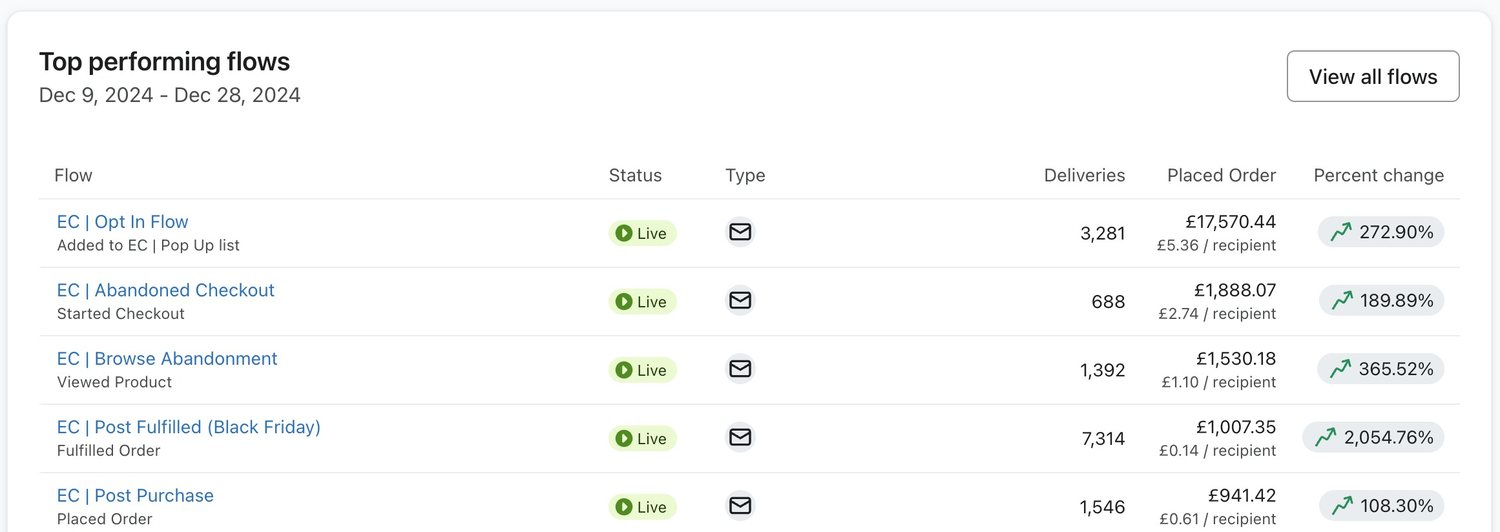
The two post-purchase rows in that account are the ones doing this job. They reach somebody who has already paid, at the only moment when your brand is genuinely interesting to them. That's why they earn per recipient in a way a campaign can't.
Four things, and only one of them is an email
Let's be honest about this one: repeat rate is a product and operations number that email can help with. If the first order turns up late or the product disappoints, no amount of follow-up fixes it, and the follow-up reads as nagging.
- Whether the delivery and the unboxing matched what was promised
- Whether there is a sensible second thing to buy, and whether you told anybody about it
- Timing: reaching people when the first purchase is running out, not on a fixed monthly calendar
- Whether the second order is easier than the first, which is usually an account and checkout job
The email part is the post purchase flow, and it's worth building before any campaign calendar, because it runs for every customer without anybody scheduling it.
Not retention, not churn, not repeat order share
Retention rate asks whether a customer is still active. Churn asks who has left. Repeat purchase rate asks something narrower and more useful: did the first order lead to a second one. The glossary has the neighbouring terms, and the Shadow Foam write-up shows the whole quarter these figures came from.
Theo Tziapouras
Founder and strategy at Engage Commerce, the ecommerce agency for 7 and 8 figure DTC brands.
FAQs

What is a good repeat purchase rate?
It depends entirely on what you sell. A consumable people finish in a month should be far higher than a piece of furniture, and comparing the two tells you nothing. Judge it against your own last year on the same window. That's the only comparison with your customers in it.
How is it different from repeat customer rate?
They're usually the same thing described differently, which is exactly why it's worth writing your own definition down. The one to watch is repeat order rate. That counts orders, not people, so it climbs whenever your best customers start ordering more often, without a single new customer coming back.
Which email flow moves it most?
The post purchase sequence, because it reaches every buyer at the moment they've just decided to trust you. Replenishment matters more for consumables, and a winback is worth running for people who have already lapsed, but the first follow-up is the one that changes the second order.
How long should I wait before measuring it?
At least as long as your typical gap between orders, and then some. Measure a cohort that's two months old and almost nobody will have come back, because most of them haven't had the chance yet. Twelve months is a safe default for most ecommerce brands.
The number that decides whether you own an audience or rent one
A brand with a low repeat rate has to buy its revenue again every month, and that price goes up every year. A brand with a healthy one is compounding quietly in the background. It's the slowest number on the dashboard to move, and the only one that keeps paying after you stop pushing it.
Terms, defined properly
One term, answered in full, then linked into the glossary entry.

What is RFM segmentation, and how to use it without a data team
Recency, frequency and monetary value, sorted into groups a marketer can actually write an email to.
Read it
What is RFM segmentation, and how to use it without a data team
Recency, frequency and monetary value, sorted into groups a marketer can actually write an email to.
Read itWould you rather this was just handled?
Bring your Klaviyo account and the thing annoying you most. We will tell you what we would fix first, before you spend anything.

Half an hour with Theo, our founder.
We're all about relationships built on trust, mutual respect and a shared vision for success. If that sounds like your vibe, let's make some waves together 🌊