The welcome flow discount is costing you more margin than it earns
Most welcome discounts were copied from a template, not chosen. Compare welcome flow order value against sitewide before you keep paying the toll.


A client asked why their welcome flow wasn't converting like it used to. Email one opened with a discount nobody could explain, copied from a template two agencies ago and assumed load bearing ever since. We tested pulling it. New customer revenue went up.
Nobody chose that discount, it shipped with the template
The first email in that client's flow led with a discount code straight out of the box. We asked where the number came from. Nobody could tell us. It had been there since launch, copied from a Klaviyo template two agencies ago.
Every person who touched the account assumed the code was load bearing. It wasn't. That's the ordinary way a welcome flow rots: not through a bad decision, but through a decision nobody remembers making.
This isn't a discounts are bad argument. The habit worth breaking is opening the flow with a blanket code because that's what welcome flows do. It's a toll, and nobody's checked whether you still need to pay it.
Work out which job the discount is actually doing
A welcome discount can only do one of two jobs. It either wins a customer who was never going to buy without it, or it hurries up somebody who was already going to buy. Different jobs, different economics, and most brands never separate them.
| The bargain hunter | The already sold | |
|---|---|---|
| Why they bought | The code tipped them over | They already wanted the product |
| What happens next | They wait for the next code | They buy again on the product's strength |
| What the code did | Bought a customer who may never pay full price | Gave away margin on a sale already made |
The customer who needed the code is price sensitive. They'll be price sensitive again at the second order and every sale after it. Repeat purchase gets decided in the gap between order one and order two, and a discount led signup starts that gap on the back foot.
The one who was already sold is quietly costing you money. If your product has real demand, a chunk of your signups handed over their email because they want the thing. The code is margin given to people who never asked for it, on every one of those orders.
Compare welcome flow order value against the rest of the site
One check tells you which job your code is doing, and it takes an afternoon. Pull the last ninety days of welcome flow orders and set their average order value against the sitewide average. The gap between those two numbers is your diagnosis.
If welcome flow order value sits well below the site, the offer's pulling in bargain hunters instead of converting fence sitters. If the two are roughly in line, the discount probably isn't why most of those people bought.
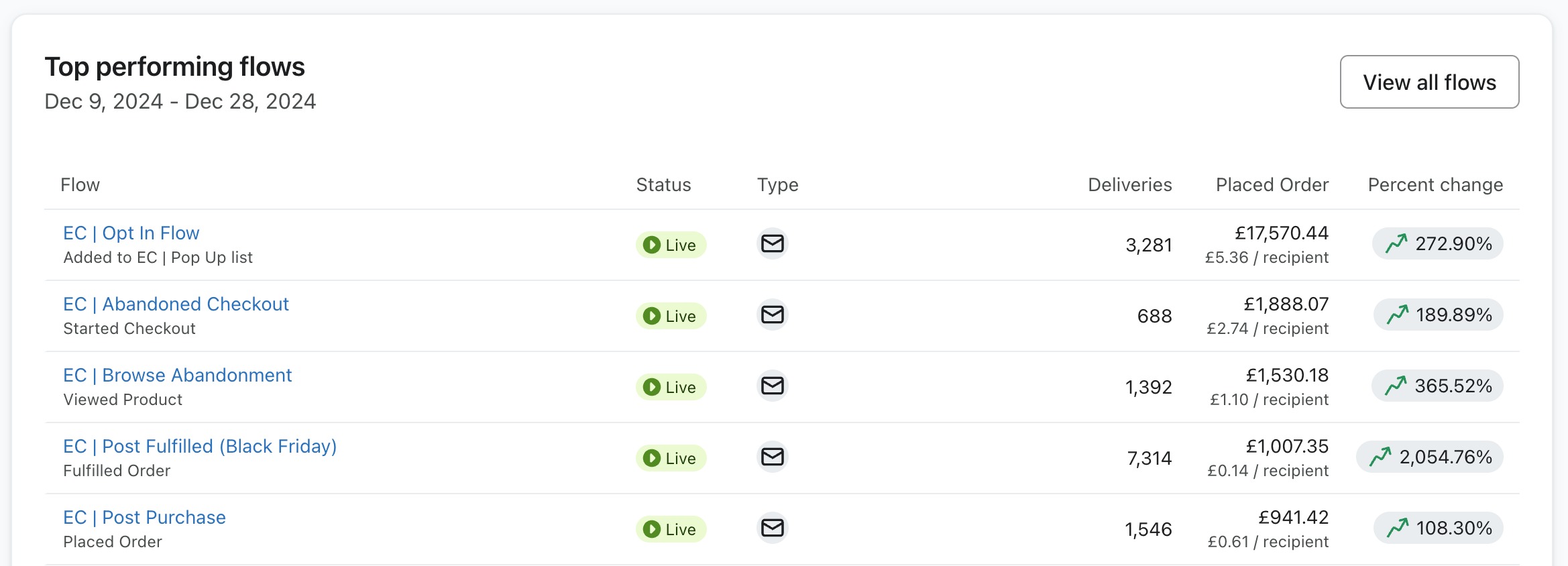
We read a report like that in revenue per recipient, not the conversion column, and that's how we judge every flow across the accounts we run. A flow that converts brilliantly while dragging order value down isn't a top performer. It's a leak with good optics.
Run a value led first email against the code before you decide
The test we ran wasn't remove the discount and hope. It was a straight split, same structure, same timing: one arm led by the code, the other led by value. What the product does, the proof it works, the founder's reason for making it.
The value led arm converted at a lower rate. That's expected, because some people genuinely won't buy without an incentive. But everyone it did convert paid full price, and the recovered margin outran the lost conversions. Fewer people through the door, more money staying per person.
A conversion rate on its own tells you nothing about profitability, and on a dashboard the discount arm looks like the winner. Run both arms through margin per send and the value led one can still come out ahead, because it isn't subsidising buyers who'd have paid full price anyway. Give the test a full flow cycle, sixty to ninety days. Then judge it on margin banked.
Know when the discount genuinely earns its place
Look, this only works if your product and your proof are ready to do the job the code used to do. Pull it from a brand people don't trust yet and you'll wreck conversion, and we'd tell a client that to their face before running the test.
- You're a genuinely new brand with no repeat history and no reviews at volume, so the code is doing trust building work a value led email can't do alone yet
- Your order value is so low the code barely dents margin per unit, because a small amount off an impulse buy behaves differently to the same cut on a considered purchase
- Your category expects a first purchase code and every competitor runs one, so going without leaves yours the only checkout with an empty box people went looking to fill
- You've got inventory or cash flow reasons to prioritise volume over margin for a set window, which is a real decision as long as somebody actually made it
If none of those apply, and especially if you've already got returning customers, decent reviews and organic demand, you're very likely the brand at the top of this page. The code runs because it's always been there. Not because anyone tested whether it needs to be.
Rebuild the flow around the reason people signed up
Pull the code and the rest of the flow has to earn the sale, because you've removed the thing doing the persuading. This is where the welcome flow stops being an introduction and starts being a selling document, and where it overlaps with the conversion testing we run.
Email one answers the question the signup implied. Somebody who joined from a blog post about ingredients wants ingredients. Somebody off a TikTok link wants the thing they saw, fast, with proof it's real. Generic welcome copy only ever worked because the code underneath was doing the lifting.
Email two carries your best proof. Reviews with specifics instead of a star graphic, or a founder explaining the problem the product solves. Email three is the last full price push before you decide whether a smaller, later incentive is worth reintroducing. If it comes back, it comes back as urgency for fence sitters, never as the headline of the flow.
Theo Tziapouras
Founder and strategy at Engage Commerce, the ecommerce agency for 7 and 8 figure DTC brands.
FAQs
Should I remove the discount from my welcome flow?
Not blindly. First compare welcome flow average order value against your sitewide average over the last quarter. If the two sit close together, a chunk of those buyers were already sold before the code mattered, and that's your signal to split test a value led first email against the offer.
What do I send in a welcome email without a discount?
Answer the question the signup implied. Lead with what the product does and why it works, then follow with specific reviews, a founder explaining the problem it solves, or a comparison against whatever they're switching from. Generic welcome copy fails without a code because the code was doing all the persuading.
How long should a welcome flow discount test run?
A full flow cycle, usually sixty to ninety days. A short sample rewards whichever arm converts fastest, and that's nearly always the discount. Judge the arms on margin per send across real cohorts, not on the conversion rate a dashboard shows you after a few days.
The code is a decision, not a default
Some people will never buy without an incentive, and no amount of better copy changes that. But pull the discount and every email has to justify itself on the strength of the product. That's a healthier place to trade from than a number nobody chose. Open the flow this week, find the code in email one, and ask who decided it should be there.
Flows and automation
The automated journeys that earn while nobody touches them.

Email Automation Alchemy: Turning Clicks into Cash for Your Ecom Empire
The essential email automation flows for ecommerce: welcome series, abandoned cart, post-purchase, re-engagement, personalisation and seasonal timing.
Read it
A quiz funnel is a segmentation tool wearing a fun hat
Quizzes earn the signup, then most brands file the answers and send one welcome series to everyone. Every question should change which emails someone gets.
Read it
If your welcome flow still mentions Black Friday in March, your seasonal email flows need a toggle
The sale line goes in by hand in November and quietly rots until spring. One permanent flow with a swappable sale block fixes it.
Read itWould you rather this was just handled?
Bring your Klaviyo account and the thing annoying you most. We will tell you what we would fix first, before you spend anything.

Half an hour with Theo, our founder.
We're all about relationships built on trust, mutual respect and a shared vision for success. If that sounds like your vibe, let's make some waves together 🌊