Your second purchase rate is where most ecommerce brands actually die
One order is a coin toss on a discount code, not loyalty. The gap before the second order is where retention is actually decided.
Acquisition keeps climbing and the business still feels like it's standing still. Pull the numbers on an account like that and it's almost never the ads. It's that hardly anybody who bought once buys again, because first-time buyers get folded into the newsletter before they've decided whether you're a habit.

Retention fails long before the loyalty programme gets involved
Retention gets talked about as a loyalty problem. The VIP tier, the customer on their sixth order, the subscription ticking along nicely. By the time somebody's on order six, retention has already worked. The programme is celebrating survivors.
The leak that actually costs brands sits much earlier and gets almost no attention. The gap between a first order and a second is where the money quietly leaves. Close it properly and every retention curve you build afterwards gets easier.
We hear the same sentence from founders every month in different words: acquisition looks great, so why does the business feel like it's standing still. The answer is rarely the ads. It's that the second order never got a plan of its own.
One order means they tried you, not that they chose you
Most first orders happen on a discount code, a good ad or a friend's recommendation. The customer's relationship is with the deal, not the product range, and definitely not your newsletter's opinion on the new season colours. Nothing about that order says they've decided to come back.
The mistake is treating that person as an existing customer the moment the confirmation sends. They get merged into the general list and get the same broadcasts as somebody four orders deep. Nothing in their inbox acknowledges that they're one order in and still deciding.
First-time buyers need their own track, built to answer the only question that matters to them yet: was that first purchase worth repeating. The brand story and the wider catalogue can wait until that's settled.
Time the second purchase push off the product, not the calendar
Most versions of the post-purchase flow run on fixed intervals. An email a week after delivery, another a week after that. That ignores the one variable deciding whether the email lands or gets ignored: what the person actually bought.
A consumable that empties in five or six weeks needs its push around week four, while there's product left and the customer's starting to think ahead. Send a generic thirty-day email and it either arrives too early to matter or lands after they've run out and gone looking on Amazon. A durable product needs a different second act. Built around what naturally follows it.
So one flow can't do this job. It needs branching off product category, or ideally the actual item, so the serum buyer and the one-off homeware buyer sit on different timers. Setting each timer off the replenishment cycle of what was bought is the single biggest fix most brands can make here.
Recommend what follows the first purchase, not the bestseller feed
Get the timing right and the content is where it falls apart next. Too many second-purchase emails default to bestsellers or a generic you-might-also-like widget. That's a missed connection wearing a personalisation label.
The stronger version reasons from the item itself. The coffee grinder buyer should see beans and filters, not another kitchen gadget. The buyer of one foundation shade should see the concealer built to sit alongside it, not a rival shade they've no reason to own. It's a mapping exercise, done product by product, and none of it is complicated.
Treat the pairing as a test, not a guess. The obvious complementary product is often not the one that converts, so let the email prove which pairing earns the click before you hard-code it.
A working first-to-second track has five things true at once
- It triggers for first-time buyers specifically, separate from the general newsletter and the catch-all thank-you sequence
- Timing is set per product category or replenishment cycle, never one fixed delay for the whole catalogue
- The recommendation is mapped to the item actually bought, not pulled from a bestseller feed
- The copy still assumes the customer's undecided, instead of borrowing the loyal-customer voice
- If the second order doesn't come, the customer graduates back into general lifecycle messaging instead of sitting in limbo
Most brands already have some version of this live, and very few clear all five at once. It's usually the timing and the recommendation logic that fail. Fixing those two is a far smaller job than rebuilding the flow from scratch.
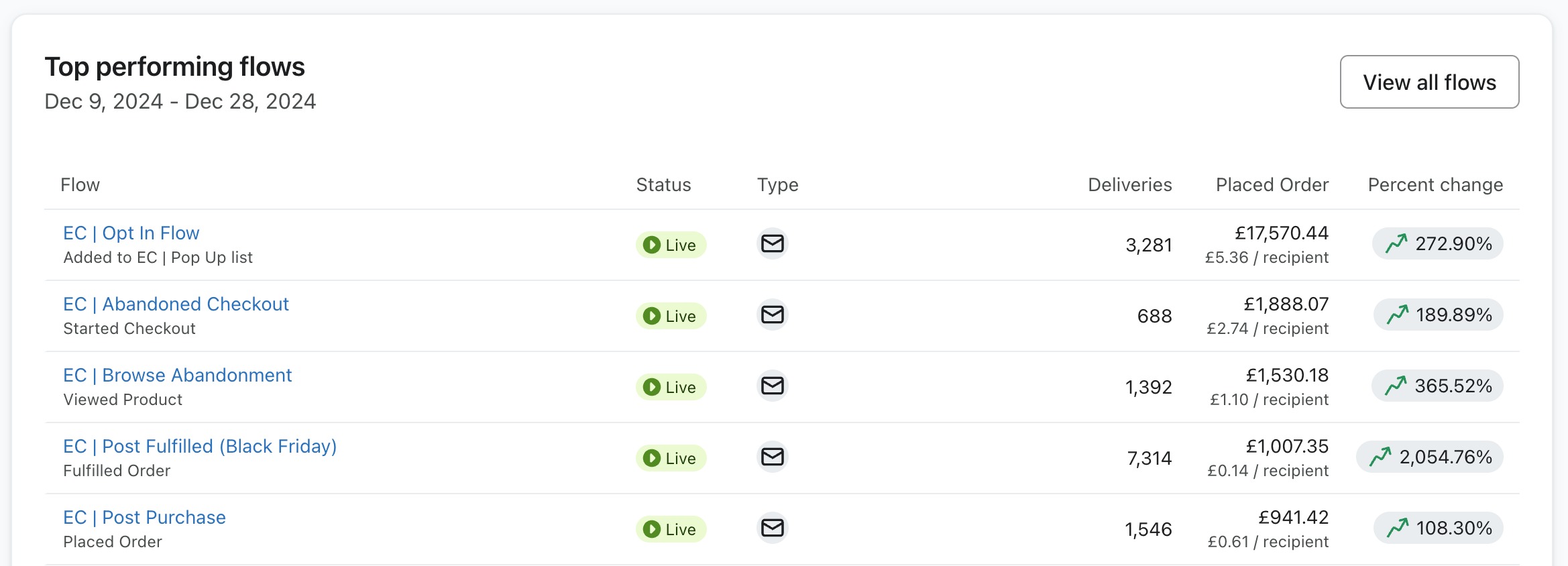
A report like that will happily show a post-purchase flow as live and earning. It'll never tell you that every buyer inside it sits on the same timer, which is the actual fault in most accounts.
Open the flow and check two things before you build anything
Open your post-purchase flow in Klaviyo and look at exactly two things. First, whether every product category shares one timing. Second, whether the product block in the second or third email is a generic feed or something mapped to what the customer bought.
If both come back as one generic template, you've found the gap costing you the most repeat customers. It's the pattern we see on most of the accounts we take over, and it's a smaller fix than most of the retention work brands go looking for first. The loyalty tier and the subscription push both get easier once it's closed.
Theo Tziapouras
Founder and strategy at Engage Commerce, the ecommerce agency for 7 and 8 figure DTC brands.
FAQs
What is a good second purchase rate?
There's no single benchmark worth trusting, because consumables, durables and gift-led categories repeat at completely different speeds. The honest read is your own trend: measure the share of first-time buyers who come back within a sensible window for your product, then watch whether that share moves after you change the flow.
How soon after a first order should I email a first-time buyer?
Send the thank-you and the proof early, then put the second ask on the product's own clock. A consumable earns its push while there's still some left. A durable earns one when the natural next item becomes relevant. The calendar alone should never decide it.
Should first-time buyers get the general newsletter?
Not straight away. They haven't decided whether the brand's a habit, and broadcast content written for loyal customers reads as noise to somebody one order in. Hold them on a dedicated track until the second order lands or the track ends, then graduate them into the normal cadence.
Do I need a separate flow for this in Klaviyo?
Yes, or at least a dedicated branch only first-time buyers can enter. The trigger filters on placed order count, the timing splits by product category, and the exit hands people back to general lifecycle messaging. Build it inside the newsletter audience and you've defeated the point of the track.
The second order is the business
A first order proves the ad worked. The second proves the brand does, and everything compounding about ecommerce revenue starts there. Build the track that asks for it properly, timed to the product and written for somebody still deciding, and the rest of the retention curve stops being an uphill argument.
Flows and automation
The automated journeys that earn while nobody touches them.

Why are my abandoned cart emails not working? Check the product page they point back to
When opens and clicks hold steady but completed checkouts fall, the blocker is on the other side of the click, not in your emails.
Read it
Your welcome flow audit is two years overdue
Expired codes, missing product lines, a tone from two hires ago: a flow can be live and confidently wrong, and nothing will flag it.
Read it
We only start adding SMS to Klaviyo flows after email has failed twice
SMS enters a flow only after two emails went undelivered or unopened. A text opt-out is far harder to win back than an ignored email.
Read itWould you rather this was just handled?
Bring your Klaviyo account and the thing annoying you most. We will tell you what we would fix first, before you spend anything.

Half an hour with Theo, our founder.
We're all about relationships built on trust, mutual respect and a shared vision for success. If that sounds like your vibe, let's make some waves together 🌊