The risk reversal email: sell the guarantee, not the product
Most brands publish a returns policy and never mention it again. Sent as a campaign, the same terms answer the objection nobody writes in.


The last doubt before a first order is almost never about the product. It's about what happens if it's wrong. Answer that directly, as a campaign instead of a link in the footer, and it's one of the highest converting sends available to a brand that has never done it.
What happens if it's wrong
Think about where somebody actually is by the time they've read the description, checked the reviews and put it in the basket. What's left isn't about quality. It's the private sum about being stuck with it, and about how difficult you'll be if it doesn't work out.
Almost nobody emails to ask. They just don't order. That's why this objection is invisible in your support inbox and obvious in your conversion rate.
Four levels, in ascending order of nerve
| Level | The promise | What it costs |
|---|---|---|
| The statutory one | Your legal obligation, stated clearly | Nothing, and it persuades nobody |
| Extended returns | Longer than required, stated in days | Very little in practice |
| Free return postage | You pay to take it back | Real, and usually smaller than expected |
| Use it and see | Return it opened, used, part finished | The most, and it converts the most |
Most brands sit on the first row and call it a guarantee. Moving one row down is usually the cheapest conversion improvement you've got, and the campaign announcing it is what makes anybody aware of it in the first place.
No conditions in the same sentence as the promise
A guarantee undermined by its own caveats is worse than no guarantee, because now the reader has a list of ways it might not apply. State the promise in one plain sentence. Then deal with the genuine exceptions underneath, honestly.
- Say what somebody gets back, and how long it takes to arrive
- Say who pays for the return, in the same breath
- Say what they have to do, in the fewest steps you can manage
- Say what isn't covered, plainly, instead of burying it in terms
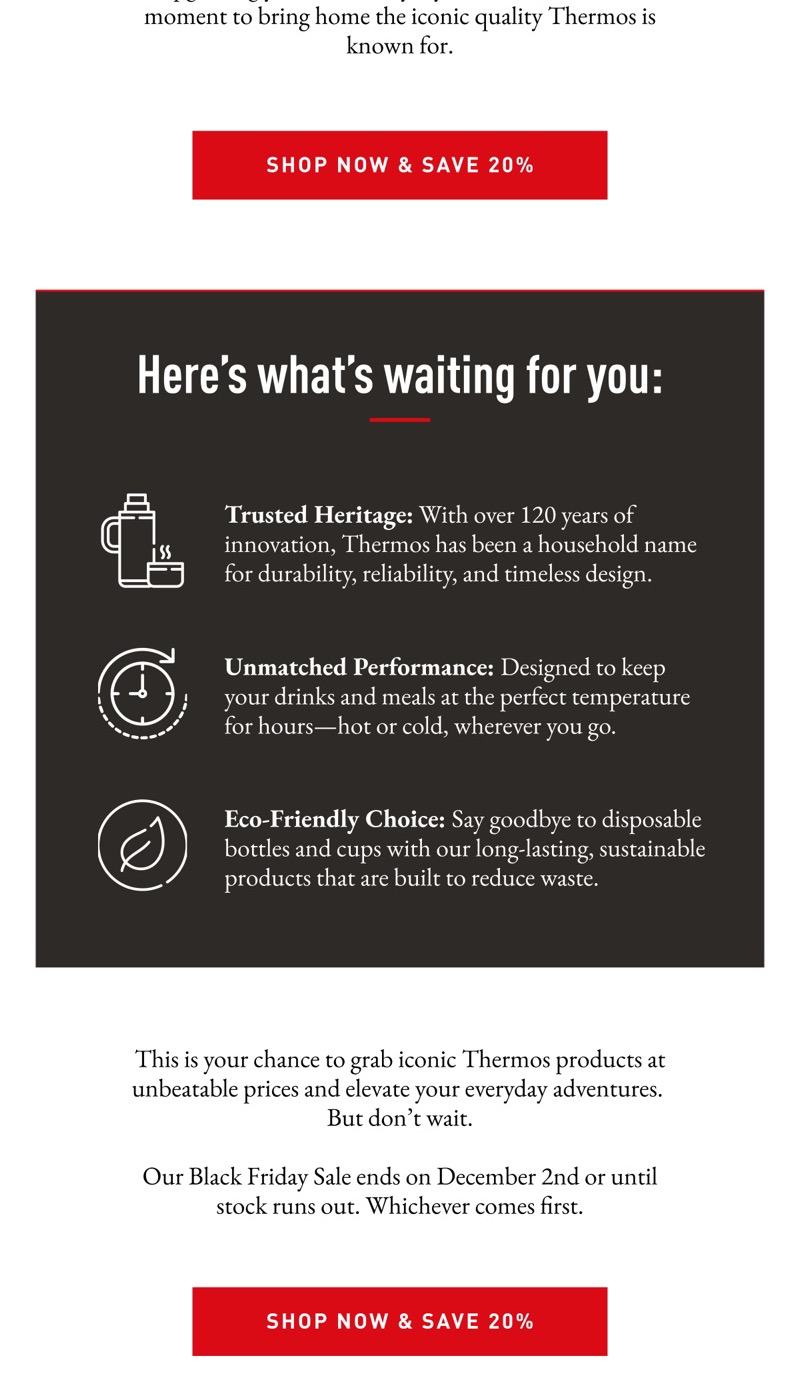
That reasons to buy panel is risk reversal working inside another campaign, and it's the version most programmes should run permanently once the standalone send has gone out.
A stronger guarantee usually lowers returns
The objection to improving a guarantee is that people will take the mickey. In practice a clearer promise tends to cut returns, because customers who felt confident buying are better matched to the product than customers who hesitated and guessed.

It cuts the arguments too. A generous, plainly stated policy takes the negotiation out of every return conversation, which is time your support team currently spends on cases it always ends up conceding anyway.
A campaign once, then everywhere permanently
Send it as a standalone campaign to subscribers who've never bought, because for them it's genuinely new information. After that it shouldn't need its own send again. It belongs in the places where the doubt actually happens.
The second email of the abandonment sequence is the strongest of those, since the reader has already chosen and is doing the private sum. Putting the guarantee there is one of the reliable improvements to a cart sequence, and it usually beats adding a discount to the same email.
Find your own returns policy the way a customer would
Open your own site on a phone and try to find out what happens if something doesn't fit or doesn't work, without using the search box. Time yourself. In most accounts it takes longer than a customer would ever spend, and the answer reads like a legal document.
Rewrite it as a sentence somebody would say out loud, put that sentence on the product page, in the basket and in the abandonment sequence, then send the campaign. That's a conversion project as much as an email one, and it's usually the cheapest one on the list.
Theo Tziapouras
Founder and strategy at Engage Commerce, the ecommerce agency for 7 and 8 figure DTC brands.
FAQs
Will a stronger guarantee increase returns?
Usually not by much, and often it's the opposite. Customers who buy confidently tend to be better matched to the product than customers who hesitated and guessed, and any small rise in returns is generally outweighed by the orders that happened at all.
Should the guarantee be in every email?
Not as a campaign, but as a line in the footer or a small panel in your conversion focused sends, yes. It costs nothing to include and it answers the doubt at the moment somebody is deciding, which is the only moment that counts.
What if we cannot afford free return postage?
Then extend the window instead, which costs almost nothing, and be honest about who pays. A clearly stated policy where the customer pays to return beats a vague promise that reads as generous and turns out not to be.
Where does risk reversal work hardest?
In categories where fit, suitability or a visible result is uncertain, and with first time buyers of anything above an impulse price. Existing customers have already tested how you behave, so for them it's reassurance instead of persuasion.
Answer the question nobody asks
Risk reversal converts because it deals with the last private doubt before a first order. Improve the promise by one level. State it in a sentence with no conditions hanging off it, put the exceptions underneath where they belong, and send it to everybody who has never bought. Then move it into the basket, the product page and the abandonment sequence, and it carries on working without ever being sent again.
Campaigns that are not discounts
One campaign type per post: what it is for, who it is sent to, and how to build it without reaching for a code.
The restock email, and why it is not the back in stock alert
One is an automation for the people who asked. The other is a campaign for everybody who wanted it and never said so.
Read it
The product tutorial email, sent when the box has just landed
A customer who uses the product properly the first time buys again. One who gets it slightly wrong quietly decides it was not for them.
Read it
The press roundup email: borrowed credibility, spent properly
A logo bar of publications proves you have a publicist. A quoted sentence from a journalist who tested the thing proves something else entirely.
Read itWould you rather this was just handled?
Bring your Klaviyo account and the thing annoying you most. We will tell you what we would fix first, on the call, before you spend anything.

Book a call with our founder.
We're all about relationships built on trust, mutual respect and a shared vision for success. If that sounds like your vibe, let's make some waves together 🌊