Your email open rate dropped suddenly: what to check, and in what order
Opens are a soft number now. A collapse still means something, and it is almost never the subject line.


Open rate is the number everybody watches and the number that lies most often. When it falls off a cliff the cause is rarely the words at the top, and sometimes it isn't a real fall at all. Work through it in this order.

Work out whether the number fell before you explain why
An open gets recorded when a tracking pixel loads. Apple Mail Privacy Protection loads that pixel on the reader's behalf, whether or not the person ever looked at the message. A share of every open rate you've seen was never a human being.
That share isn't stable either. It moves with the device mix in your audience and with how Apple handles pre-loading on a given day, so an open rate can drop several points without a single thing changing at your end.
Nothing in the reporting separates the two for you. Machine opens and human opens land in the same column. So the first question isn't why the number fell. It's whether anything fell.
Then look at who was in the send, not what was in it
The audience changes the number far more than the creative does. A send to everyone who's ever given you an address will always open lower than a send to people who bought last quarter, and the two aren't comparable.
Those three went out inside a week to broadly the same people, and each one opened a little lower than the one before it. Nothing was wrong. The same audience was asked the same question three times, and the third ask is always the quietest.
So before anything else, put the two sends side by side and check the segments underneath the campaign names. Half the collapses brands bring to us are a small engaged segment in March being compared against the whole list in April.
A real fall usually means placement, not content
If the audience genuinely matches and the fall holds across several sends, you're looking at a deliverability problem. The open rate is the symptom, not the disease.
- Bounces and spam complaints in the same period, which move before opens do
- Anything that changed in DNS, including a new sending domain or a helpdesk somebody added
- Whether the fall is at one mailbox provider or all of them, which tells you a lot on its own
- A big send to a segment that hadn't been emailed in months
- Whether unsubscribes rose at the same time, which points at the audience and not the inbox
The split by mailbox provider is the most useful of those and the least used. A fall at one provider only is a reputation problem with that provider. A fall everywhere at once is usually you, or the reporting.
Two numbers that look the same and are not
| What people compare | Why it moves on its own |
|---|---|
| A flow against a campaign | Flows reach people at their own moment, so they open higher and always have |
| This month against last month | Peak trading changes who is on the list and how often they hear from you |
| A resend against the original | The resend goes to the people who did not open the first one, by definition |
| Your rate against a published benchmark | The benchmark counts somebody else's audience, devices and sending pattern |
The last row deserves its own warning. Comparing your account against an industry average tells you almost nothing, because you don't know what's inside the average. Your own last quarter is the only benchmark with your customers in it.
The numbers that did not change when Apple changed the rules
Clicks, placed orders and revenue per recipient all came through Mail Privacy Protection intact, because none of them can be triggered by a machine loading an image. They're also the numbers your finance director already cares about.
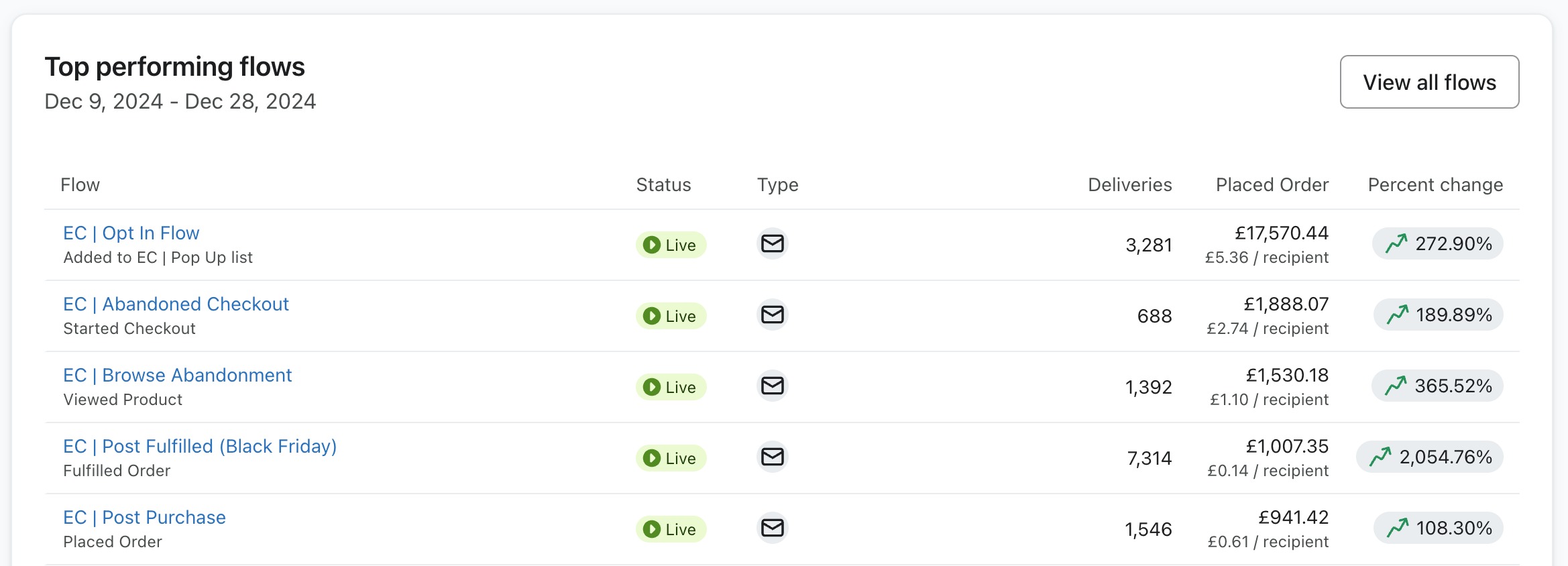
There's no open rate column in that view, and nobody has ever asked us to add one. Deliveries, orders and revenue per recipient answer the question opens were being used as a proxy for.
Keep the open rate on the dashboard by all means. Use it as a smoke alarm and not a scoreboard: worth investigating when it moves sharply, worth ignoring when it drifts. Want the vocabulary written down? The glossary has the rest of these terms.
The order to work through it in, and when to stop
- Confirm the two sends went to comparable segments, in the reporting and not from memory
- Check bounces, complaints and unsubscribes over the same period
- Split the last few sends by mailbox provider and see whether the fall is everywhere
- Confirm nothing changed in DNS or in the from name, including things other teams did
- Look at clicks, orders and revenue per recipient, and see whether they fell with the opens
- Only then change the creative, one thing at a time, and give it several sends
If clicks and orders held while opens fell, you've got a measurement story and nothing to fix. If they fell together, you've got a deliverability story, and what we do inside Klaviyo starts in the same place: the list, the domain and the sending pattern, before anybody argues about words.
Theo Tziapouras
Founder and strategy at Engage Commerce, the ecommerce agency for 7 and 8 figure DTC brands.
FAQs

Is open rate still worth tracking at all?
As a trend on your own account, yes. It's useful for spotting a sudden change and useless for judging whether an email was any good. Track it, watch it for sharp movements, and never let it decide which campaign gets repeated. Clicks and orders should do that job.
Why did my open rate rise after Apple's change?
Because machine opens got added to real ones. Plenty of accounts saw the number go up while revenue stayed flat, which told everybody at once that the metric had gone unreliable. If your rate rose in that period, the baseline you're comparing against today is inflated.
Could a subject line really cause a big drop?
Rarely on its own, and never across several sends. A weak subject line costs you some of the people who were going to open anyway. A deliverability problem or a change of audience costs you all of them, and that's what a collapse actually looks like in the reporting.
Should I resend to people who did not open?
Sparingly. A resend goes to the least engaged part of your audience, so it'll open badly and it pushes more mail at people who ignored you once already. Do it for a genuinely important send, not as a habit, and never to people who have ignored months of email.
The open rate was never the number
It became the headline metric because it was the easiest thing to count, and it stayed there long after it stopped meaning what people thought it meant. A brand that moved its reporting to clicks, orders and revenue per recipient two years ago is having calmer conversations today. And making better decisions about what to send next.
Deliverability and UK consent
Getting into the inbox, and staying inside UK GDPR and PECR while you do it.

How to set up DMARC for Klaviyo, and what SPF and DKIM do first
Three DNS records, one order to publish them in, and the mistake that stops a Shopify brand's sends reaching anybody at all.
Read it
Why are my emails going to spam, and what to check first
A diagnosis order that finds the fault: authentication, then the list, then the sending pattern, then the content.
Read it
UK GDPR email marketing consent: what a lawful sign-up looks like
What the ICO expects from an ecommerce sign-up form, written by people who configure them rather than people who argue about them afterwards.
Read itWould you rather this was just handled?
Bring your Klaviyo account and the thing annoying you most. We will tell you what we would fix first, before you spend anything.

Half an hour with Theo, our founder.
We're all about relationships built on trust, mutual respect and a shared vision for success. If that sounds like your vibe, let's make some waves together 🌊