Ecommerce email marketing benchmarks UK brands quote, and what to use instead
Published averages describe accounts you can't see. The comparison that works is your own last period, same segments, same season.


A benchmark table averages accounts with different products, different prices and different list ages. It can't tell you whether your last quarter was any good. Your own previous quarter can, and it's already sitting in the account, waiting to be read properly.

A benchmark is an average of accounts you can't see
Look, every benchmark table is built by pooling accounts with different products, different prices, different list ages and different countries. Average all that and you get a number describing nobody in particular. It's still the first thing people reach for when a report looks bad.
The useful comparison is narrower and duller. This quarter against the same quarter last year, on the same segments, in the same account. It's the only pair where everything except your own work is held still.
Read who built the benchmark before you read the benchmark
Platforms publish benchmarks from their own customer base. Agencies publish them from their own client roster, which is a sample of brands that hired an agency. Neither one is dishonest. Both are describing a population you never applied to join.
- Whose accounts are in it, and how many of them
- What counts as your industry, and how wide that net is
- Which months it covers, because peak flatters everything
- Whether flow and campaign sends are pooled or split
- What attribution window produced the revenue numbers
Klaviyo's own peer benchmarks are the most useful of the lot, because the platform defines the peer set and holds the data itself. Even then, a peer set like housewares, home and garden holds a lot of businesses that aren't yours. Use it as a direction. Never as a target.
Open rate benchmarks stopped meaning much some years ago
Apple's Mail Privacy Protection pre-fetches images for Apple Mail users, so an open registers whether anybody read anything or not. Every account has a different share of Apple Mail readers. So every account inflates by a different amount.
That makes a pooled open rate benchmark close to meaningless, and it makes your own open rate history useful only after the point the change landed. Clicks, conversion and revenue per recipient survive it. Opens are a trend line now, not a score.
It matters more than it sounds, because open rate is the number most often quoted back to us in a growth consultation. Told its opens sit below the industry average, a brand goes off and rewrites subject lines. That's weeks of work aimed at a measurement artefact, not at anything a customer noticed.
What a baseline looks like when you build one
A baseline is four or five numbers, recorded on the same day each month, from the same report, with the same conversion metric selected. Attributed revenue, the flow and campaign split, revenue per recipient, unsubscribe rate, complaint rate. Enough for most brands.
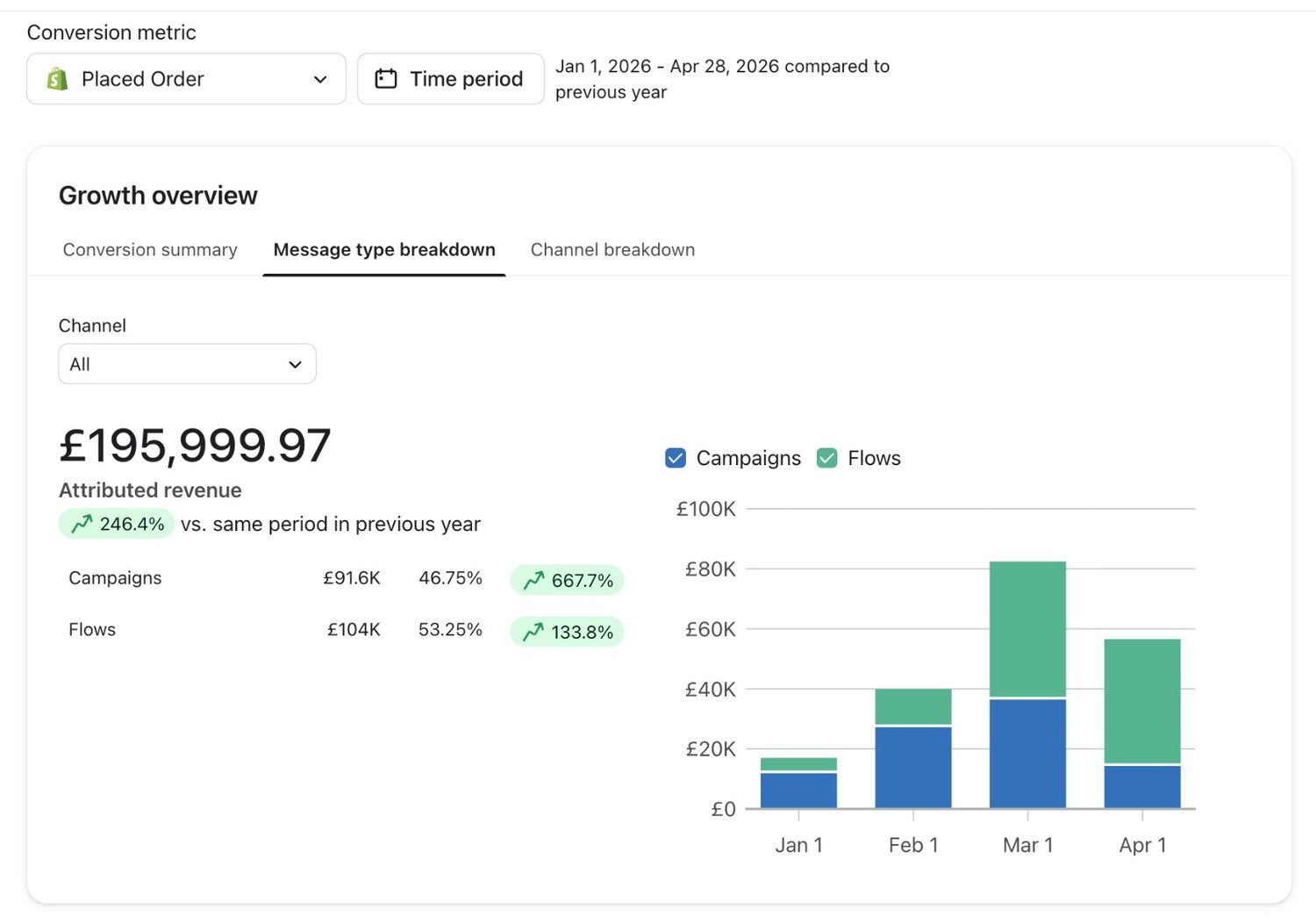
That view is the comparison worth having. It reads one account against itself over four months with the split visible, and it answers the only question a benchmark was ever standing in for. Is this better than what we were doing before.
When an outside number does earn its place
An outside range is worth quoting when you can say whose it is, what period it covers and which account you're holding it against. Strip any one of those away and it's decoration.
Same rule governs how we report. A figure with no client, no date and no link is a figure somebody chose. Read the Shadow Foam case study and you can check every number on it against the quarter it came from.
Two things a published benchmark is genuinely good at
| Question | Benchmark | Your own baseline |
|---|---|---|
| Is this number even possible? | Useful sanity check | No help, it has never seen the number before |
| Did our work move anything? | No, too many variables differ | The whole job, if the segments match |
| Should we staff this channel? | Useful in a board conversation | Better, because it's your own money |
| Which flow to fix first? | Nothing to say | Names it, by revenue per recipient |
| Is the list healthy? | Complaint ranges are worth knowing | Your own trend matters more than the range |
Both columns have a use. The mistake is asking the left one a question only the right one can answer, then rebuilding a programme because a stranger's average said so.
How to start a baseline this week
- Pick one conversion metric and never change it, because switching silently rewrites your history
- Fix the attribution window and write it down where the reporting lives
- Record the same five numbers on the same day every month
- Split flow revenue from campaign revenue, always, because they move for different reasons
- Note what you changed that month beside the numbers, so next year you can read the cause
- Wait a full trading year before you trust any seasonal comparison
A spreadsheet and a recurring calendar entry. That's the whole apparatus, and it'll out-argue every benchmark table you're ever sent. If you want the flow half of it scored first, how we build email systems starts in the same place.
Theo Tziapouras
Founder and strategy at Engage Commerce, the ecommerce agency for 7 and 8 figure DTC brands.
FAQs

What is a good open rate for ecommerce email in the UK?
There's no honest single answer any more. Apple's Mail Privacy Protection registers opens nobody performed, and every list has a different share of Apple Mail readers, so two accounts reporting the same open rate aren't comparable. Watch clicks, conversion and revenue per recipient, and read your own open rate only as a trend against itself.
Where do email marketing benchmarks come from?
Mostly from platforms pooling their own customer accounts, agencies pooling their own client roster, or surveys of people willing to answer a survey. Klaviyo publishes peer benchmarks by industry inside the product, which is the most defensible version, because the peer set is at least defined and the data is the platform's own.
How much history do I need before a baseline is worth anything?
A quarter is enough to spot something broken. A full trading year is what you need before seasonal comparisons mean anything, because Black Friday, January and the summer lull all distort a shorter window. Start recording now, so next year the comparison exists.
Should I ever use a published benchmark?
Yes, for two jobs. One is a sanity check when a number looks impossible and you suspect the report, not the work. The other is a board conversation about whether a channel deserves people and budget. Neither of those is the same as setting a target from somebody else's average.
Compare yourself to yourself, then argue about the rest
Benchmarks are a comfort. They tell you where you sit in a crowd you were never really part of, and they change nothing about what you do on Monday. A baseline is uncomfortable in the useful way: it names what happened after you changed something, in your own account, in your own currency, in your own season. Build that first and the benchmark question mostly stops getting asked.
Measurement and attribution
Which numbers are worth watching, and which ones flatter everybody who reports them.

Revenue per recipient is the number worth watching
Total revenue rewards sending to everybody. Open rate stopped meaning much in 2021. Per recipient is the one that survives both.
Read it
Is email revenue incremental, or would those people have bought anyway
Attributed revenue is a credit system, not proof of cause. The difference is measurable, and most brands have never measured it.
Read it
Flow revenue vs campaign revenue: which one to fix first
One half is a machine that runs while nobody watches it. The other is a decision somebody makes every week. They fail differently.
Read itWould you rather this was just handled?
Bring your Klaviyo account and the thing annoying you most. We will tell you what we would fix first, before you spend anything.

Half an hour with Theo, our founder.
We're all about relationships built on trust, mutual respect and a shared vision for success. If that sounds like your vibe, let's make some waves together 🌊